


🔄 Last Updated: September 3, 2026
The question I get asked most often — from developers in Lahore, marketers in Dublin, and consultants across the UK — is some version of the same thing: “Is it too late to start an AI automation agency?”
My answer, based on three years of building and running one, is the same every time. It is not too late. But the window in which this is easy to enter is closing faster than most people realise.
Nearly 80% of companies worldwide are already using some form of AI. However, the gap between the tools that exist and businesses that know how to implement them properly is enormous and growing. That gap is your business. An AI automation agency exists to bridge it — to take the technical capability that platforms like Make.com, n8n, and GoHighLevel have made accessible and translate it into measurable business outcomes for clients who do not have the time or expertise to build these systems themselves.
This guide covers everything: the business model, the services, the pricing architecture, the client acquisition playbook, and the operational structure you need to build from zero to sustainable recurring revenue. It is written from the perspective of a team that has actually done it, for clients in Dublin, Lahore, London, and beyond.
What Is an AI Automation Agency and Why Now
An AI automation agency is a service business that builds, deploys, and maintains artificial intelligence-powered workflow automation systems for other businesses. You are not selling software. You are not selling AI as a concept. You are selling specific, measurable business outcomes — faster lead response, reduced manual labour, higher conversion rates, and scalable operations — delivered through automation systems you build on behalf of your clients.
The commercial timing in 2026 is genuinely exceptional. The global AI market is projected to reach $1.8 trillion by 2030. Workflow automation alone is a $26 billion industry growing at over 23% annually. Meanwhile, the barrier to building automation workflows has collapsed. Platforms like Make.com, n8n, and Zapier make it possible for a technically competent non-developer to build production-ready automation systems in days rather than months.
The result is a structural market gap that will not remain open indefinitely. Businesses need automation urgently. The tools to build it are accessible. But the expertise to configure those tools effectively, integrate them with existing business systems, and ensure they deliver ROI — that expertise is still scarce enough to command premium pricing.
Research shows 75% of B2B decision-makers trust companies that work with specialists, while 88% prefer those offering educational content — proving that expertise and thought leadership drive client acquisition. For a new agency, this means that demonstrating genuine knowledge through content, case studies, and transparent methodology is a more effective client acquisition strategy than any cold outreach campaign.
At Logic Issue, we built our agency from zero in Ireland and Pakistan. We serve clients across both geographies and internationally. Everything in this guide reflects real decisions we made — and real mistakes we made first.
B2B AI Deployment and Automation Performance Benchmarks (2022-2026)
In 2026, the success of an AI initiative is measured by its “Time-to-Value” and “Failure Mitigation.” While Predictive Maintenance yields a massive 465% median ROI, technical complexity leads to a 12.5% incident rate. Conversely, Workflow Automation remains a high-reward entry point but suffers from a 70% initiative failure rate when process reasoning is not correctly configured. The following matrix provides a data-driven ROI benchmark across key AI use cases.
| Solution / Use Case | Median ROI | Payback (Months) | Avg. Setup Cost | Incident Rate | Performance Driver |
|---|---|---|---|---|---|
| Predictive Maintenance | 465% | 10 Mo | €50k – €100k | 12.5% | IoT Data Quality & ML Training |
| Lead Scoring (B2B) | 368% | 6 Mo | €4k – €15k | 27% | Predictive Segmentation & CRM |
| Legal Doc Analysis | 312% | 8 Mo | €20k – €50k | 4.1% | EU AI Act Compliance & Security |
| AI Chatbots (RAG) | >300% | N/A | $500 – $3k | 8.2% | Knowledge Base (RAG) Integration |
| Healthcare Intake | 160% | 9 Mo | $8k – $15k | 2.9% | HIPAA & HitL Governance |
| Workflow Automation | 88% | 6 Mo | $1k – $10k | 70% | Process Reasoning Configuration |
Step 1: Choose Your Niche Before You Choose Your Services
The single most common mistake in new AI automation agencies is positioning as a generalist. “We automate anything for any business” sounds like flexibility. To a prospective client, it sounds like you are an expert in nothing.
The most successful agencies aren’t generalists — they own their niche. A client with a specific, painful problem does not search for “AI automation agency.” They search for “lead qualification automation for law firms” or “AI chatbot for e-commerce customer support.” The agency that appears for that specific query wins the client.
Niche selection in 2026 should be driven by three criteria: where repetitive manual processes are most painful, where clients have budget to solve those problems, and where your existing knowledge gives you a credible starting advantage.
The Highest-ROI Niches for AI Automation Agencies in 2026
| Niche | Core Pain Point | Primary Automation Type | Client Budget Range |
|---|---|---|---|
| Professional services (law, accounting) | Manual document processing, client intake | Document AI, onboarding automation | $2,000–$8,000/month |
| Marketing and growth agencies | Manual reporting, content production, lead handling | SEO automation, lead pipelines | $1,500–$5,000/month |
| Real estate | Lead response speed, follow-up sequences | CRM automation, AI lead scoring | $1,000–$4,000/month |
| E-commerce | Customer support volume, returns, reviews | AI chatbot, support ticket routing | $1,500–$6,000/month |
| Recruitment and HR | CV screening, candidate follow-up | Applicant tracking automation | $2,000–$7,000/month |
| SaaS companies | Onboarding drop-off, churn signals | Zero-touch onboarding, churn alerts | $3,000–$10,000/month |
| Healthcare admin | Appointment scheduling, intake forms | AI scheduling, document processing | $2,500–$8,000/month |
You do not need to stay in one niche forever. However, starting in one niche allows you to build genuine expertise, produce case studies that speak directly to the next client’s situation, and develop reusable workflow templates that make each new project faster and more profitable.
For Logic Issue, the decision to focus on Make.com and n8n automation for marketing agencies, professional services, and SaaS companies was not arbitrary. It reflected where we had the deepest tool knowledge, the most relevant examples, and the clearest vocabulary for explaining ROI to prospective clients.
Step 2: Build Your Core Service Stack
Once your niche is clear, your service stack should follow directly from the most painful and most automatable problems in that niche. Do not build services first and then look for clients who need them. Identify the three highest-pain problems your target clients share, then build services that solve exactly those problems.
The Five Core Service Categories for AI Automation Agencies
Service 1 — Workflow Automation and Systems Integration
This is the foundational service of any AI automation agency. You build automated workflows that connect a client’s existing tools — their CRM, their email platform, their project management system, their payment processor — and eliminate the manual data transfer, copy-pasting, and status-updating that occupies hours of their team’s time every week.
The typical entry point is a lead capture and routing workflow. A form submission fires a webhook, the lead is automatically scored and categorised, a CRM record is created, a personalised response is sent, and the appropriate team member is notified — all within 90 seconds. For most small businesses, this single workflow saves 5–10 hours per week and measurably improves lead conversion rates.
Our AI workflow automation service is built on Make.com and n8n. The Ultimate Make.com Automation Guide covers the technical architecture behind the workflows we deliver.
Service 2 — AI Lead Intelligence and CRM Automation
Lead management is where most businesses lose the most revenue and where automation delivers the fastest, most measurable ROI. An AI lead intelligence system automatically captures leads from every source, enriches them with company data, scores them against your ideal customer profile, routes them to the correct sales rep or sequence, and tracks every interaction in the CRM.
A single client paying $10,000 setup plus $2,000 per month retainer represents $34,000 in first-year revenue. Just three to four clients at this level gets you to $100,000 or more in annual revenue.
Our CRM and lead intelligence automation service details the complete architecture. The Complete Guide to AI Lead Automation 2026 covers the technical build.
Service 3 — AI Chatbot Development
AI chatbots in 2026 are fundamentally different from the rule-based bots of five years ago. A modern AI chatbot powered by an LLM backend can understand nuanced questions, access a knowledge base of product and service information, qualify incoming leads, book appointments, handle support queries, and escalate intelligently to a human when the situation demands it.
For agencies, AI chatbot development is one of the highest-value services because the ROI is immediate and visible. A client who was handling 200 support tickets per week manually can reduce that to 40 with a well-built chatbot — with zero reduction in customer satisfaction and a significant reduction in labour cost. Our AI chatbot development service covers the build and deployment approach.
Service 4 — AI SEO Content Automation
For marketing agencies and content-heavy businesses, automating the SEO content pipeline is one of the most commercially valuable services an AI automation agency can offer. An autonomous content pipeline produces keyword research, article briefs, full drafts, on-page optimisation, and WordPress publishing in a fully automated sequence — with a human review gate before publishing.
Our AI SEO content automation service and the AI-Powered SEO Automation Complete Guide 2026 cover the complete delivery model and technical architecture.
Service 5 — Agentic AI Workflow Development
This is the premium service tier for 2026 and beyond. Agentic AI workflows — where an AI agent reasons, selects tools, executes actions, and adapts based on what it discovers — represent a categorically different capability from traditional automation. They handle tasks too variable and complex to hardcode: research pipelines, intelligent document analysis, multi-step lead intelligence, and autonomous client onboarding.
Our Agentic AI Workflows Master Guide 2026 covers the technical architecture. Agentic builds command premium pricing because the knowledge required to design them correctly is rare and the ROI delivered is substantially higher than traditional automation.
Step 3: Set Your Pricing Architecture
Pricing is where most new agency owners undercharge consistently and then feel undervalued by their clients. The fix is structural, not psychological. The right pricing architecture makes your value obvious, protects your margins, and creates natural pathways to recurring revenue.
The Three-Tier Agency Pricing Model
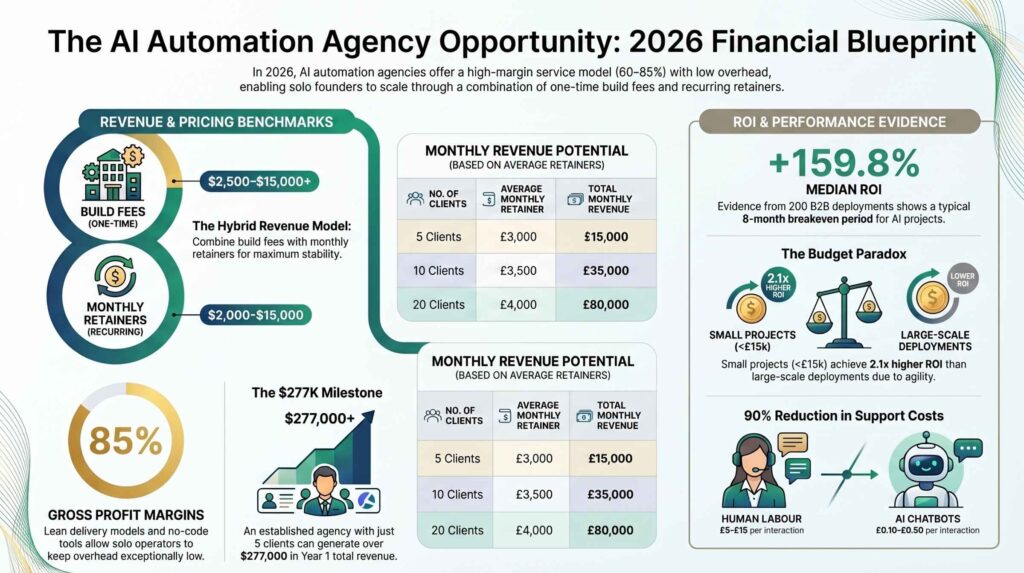
In 2026, most agencies use a hybrid approach to balance cash flow and scalability: project-based setup fees for custom builds, typically ranging from $2,500 to $15,000 or more depending on complexity; monthly retainers for ongoing maintenance, system optimisation, and support; and performance-based components tied to measurable client outcomes.
This is the exact model we recommend for Logic Issue-style automation agencies.
Tier 1 — Starter Build (One-Time Project)
Price range: $1,500–$5,000 Deliverable: One complete automation workflow solving one specific problem. A lead capture and CRM pipeline, a client onboarding sequence, or a Facebook Lead Ads to CRM connection. Timeline: 3–5 business days Purpose: Proof of value, foot in the door, portfolio building
This tier gets you your first clients quickly. It requires no long-term commitment from the client and delivers visible ROI within the first week. The goal of every Starter Build is to demonstrate the value clearly enough that the client immediately wants to know what else you can automate for them.
Tier 2 — Growth Retainer (Monthly Recurring)
Price range: $1,500–$4,000 per month Deliverable: Full automation of one business department — sales, marketing, or operations. Includes initial builds plus ongoing monitoring, credit optimisation, error handling, and monthly expansion. Timeline: 4–6 weeks initial build, then ongoing Purpose: Recurring revenue, deep client relationship, high lifetime value
This is the revenue foundation of a sustainable agency. A client on a $2,500 per month retainer represents $30,000 in annual recurring revenue. Five retainer clients at this level puts you at $150,000 ARR — a comfortable one-person agency. Ten retainer clients is a real business.
Tier 3 — Enterprise Transformation (Premium Project + Retainer)
Price range: $5,000–$15,000 setup, $3,000–$8,000 per month ongoing Deliverable: Multi-department AI automation transformation. Custom agentic AI systems, video pipelines, CRM intelligence, SEO content engines, and reporting dashboards. Timeline: 8–12 weeks initial implementation Purpose: High-value anchor clients, flagship case studies, maximum ARR contribution
Pricing by Service Line
| Service | Setup Fee | Monthly Retainer | Notes |
|---|---|---|---|
| Lead capture + CRM pipeline | $1,500–$3,500 | $500–$1,500 | Fastest to deliver, clearest ROI |
| AI lead qualification system | $2,500–$5,000 | $1,000–$2,500 | Requires ICP definition workshop |
| AI chatbot (full build) | $3,000–$8,000 | $800–$2,000 | Ongoing training and improvement |
| Zero-touch client onboarding | $2,000–$4,500 | $750–$1,500 | High retention impact for clients |
| AI SEO content pipeline | $3,500–$7,000 | $1,500–$3,500 | Content production + optimisation |
| Agentic AI workflow (custom) | $5,000–$15,000 | $2,000–$5,000 | Highest complexity, highest value |
| Full department automation | $8,000–$20,000 | $2,500–$8,000 | Multi-system integration |
Never price based on the hours you spend. Price based on the value you deliver. A lead qualification system that saves a sales team 15 hours per week and improves conversion by 30% is worth far more than the 20 hours it took to build. Clients pay for outcomes. Price accordingly.
Step 4: Build Your Portfolio Before You Have Clients
The biggest objection you will face in your first 90 days is the portfolio problem: clients want to see proof before they hire you, but you cannot build proof without clients. The solution is to build proof without client money.
Three Ways to Build a Portfolio from Zero
Build for yourself first. Automate your own agency operations — your lead capture, your proposal process, your client onboarding, your invoicing. Document every workflow with screenshots and results data. This becomes your first case study: “Here is how I automated my own agency and what it delivered.” This is a more compelling proof point than many paid client examples because it demonstrates you eat your own cooking.
Build for charities or non-profits at no cost. Non-profit organisations have identical automation needs to commercial businesses — donor management, volunteer coordination, event communications, fundraising pipelines — but rarely have technical resources to address them. Build one or two workflows for a non-profit organisation in Dublin or Lahore, document the before-and-after results, and you have a legitimate case study that demonstrates real-world impact.
Build demo systems. Create working demonstration systems for the most common use cases in your target niche — a fully functional AI lead qualification pipeline, a zero-touch client onboarding system, or an AI chatbot with a real knowledge base. Walk prospective clients through these demos on sales calls. A live demo of a working system is worth ten slide decks.
For a model of how real case studies should be documented, review our workflow automation case studies. The key elements are: the client’s situation before automation, the specific workflows built, the measurable results delivered, and the ongoing impact.
Step 5: Land Your First Clients
Client acquisition is where most technically skilled agency founders struggle. Building automation systems is a learnable technical skill. Persuading a business owner to trust you with their operations requires a different competency — one that is equally learnable but requires deliberate practice.
Client Acquisition Channel 1 — Inbound Content (Highest Quality, Slowest)
Writing genuinely useful content about automation — tutorials, guides, case studies, comparison articles — attracts the highest-quality inbound leads. A business owner who finds your guide to automating lead qualification with Make.com, implements some of it themselves, and then decides they would rather pay you to do the rest is a pre-qualified, high-trust prospect.
This is the long game. Inbound content does not produce leads in week one. It compounds over 6–12 months and then produces a consistent stream of warm, high-intent inquiries. Our entire content strategy at Logic Issue — including the pillar articles on Make.com automation, AI lead automation, and agentic workflows — is built to attract exactly this type of reader.
Furthermore, optimising content for AI search citation (via GEO tactics covered in our AI SEO automation guide) means your articles increasingly appear in ChatGPT, Perplexity, and Google AI Overview responses — reaching high-intent prospects who are actively researching automation solutions.
Client Acquisition Channel 2 — LinkedIn (Fastest for Demonstrating Expertise)
LinkedIn in 2026 is the highest-ROI client acquisition channel for B2B service businesses at the early stage. Three posts per week consistently, showing real automation builds, real results, and genuine insight about the problems your clients face, produces inbound interest within 30–60 days of consistent posting.
The key is specificity. “We help businesses with AI” generates zero response. “Here is a Make.com workflow I built this week that cut a client’s lead response time from 4 hours to 3 minutes — here is the exact scenario structure” generates direct messages, connection requests, and sales calls.
Show the work. Document the results. Explain the thinking. LinkedIn rewards genuine expertise shared publicly, and the AI automation niche is significantly underrepresented on the platform relative to its commercial value.
Client Acquisition Channel 3 — Direct Outreach to Warm Targets
Cold outreach works when it is genuinely targeted and genuinely relevant. Identify businesses in your niche that are clearly experiencing the pain your services solve — a law firm posting about manual intake processes, an e-commerce brand complaining about response times, a marketing agency overwhelmed by reporting work. Reach out with a specific observation about their situation and a concrete suggestion for how automation could address it.
Do not lead with your credentials. Lead with their problem. A message that says “I noticed your team manually processes Facebook Lead Ads into your CRM — I built a workflow that automates this entirely, including lead scoring and personalised follow-up. Would it be useful to see how it works?” will outperform any amount of credential-listing.
For agencies targeting clients in Dublin and Ireland, local chamber of commerce events, Irish startup communities, and LinkedIn’s Dublin business network are particularly effective targeting contexts. For Pakistan-based agencies, the Lahore tech community, remote-first SaaS companies, and the growing e-commerce ecosystem are strong hunting grounds.
Client Acquisition Channel 4 — Freelance Platforms
Upwork and Fiverr are underused by serious AI automation agencies — and that underuse is a competitive advantage. Most listings for Make.com, n8n, and Zapier automation on these platforms are low-quality. A profile with a strong case study, a clearly articulated niche, and a professional portfolio will appear in the top tier almost immediately.
Use freelance platforms specifically to collect your first three to five client relationships and the testimonials that go with them. Then use those testimonials in your own website and content. The goal of a freelance platform engagement is not the platform fee — it is the social proof and the case study.
Client Acquisition Channel 5 — Strategic Partnerships
Partnering with complementary service providers — web development agencies, marketing agencies, business consultants, CRM implementation specialists — creates a consistent stream of warm referrals from professionals who encounter automation needs in their own client work.
The logic is simple. A web developer building a new site for a professional services firm will frequently encounter the question of how to automate the contact form response process. If they have a referral relationship with an AI automation agency, they can make an introduction, add value to their client, and earn a referral fee — while you acquire a pre-qualified client without any marketing spend.
Our partner programme is built on exactly this model. If you are a consultant, developer, or service provider encountering automation needs in your client work, explore how we structure these relationships.
Step 6: Deliver, Retain, and Expand
Winning a client is one discipline. Keeping a client and expanding the relationship over time is a different and ultimately more valuable one. The economics are straightforward: acquiring a new client costs 5–7 times more than retaining an existing one. Every client retained on a monthly retainer is revenue that does not need to be re-earned from scratch next month.
The Delivery Process That Retains Clients
Every client engagement at Logic Issue follows a four-phase delivery model designed to maximise both the quality of the work and the clarity of the value delivered.
Phase 1 — Discovery (Week 1). A structured discovery session maps the client’s current process end-to-end. Where does work currently enter the system? Where does it get stuck, duplicated, or lost? What would the ideal automated version look like? The discovery session produces a written process map and a prioritised list of automation opportunities, ranked by estimated time saving and implementation complexity.
Phase 2 — Build (Weeks 2–3). The highest-priority workflow is built, tested internally against 20+ real-world scenarios, and then handed to the client for user acceptance testing. Clear success criteria — agreed in the discovery phase — define what “done” looks like. The client sees a working system, not a slide deck.
Phase 3 — Handover (Week 4). Every delivered system includes documentation: a written guide to what the workflow does, what to do if it breaks, how to modify key variables (like email content or routing logic), and who to contact for support. Clients who understand their systems are retained clients.
Phase 4 — Ongoing Optimisation (Month 2 onwards). Monthly retainer clients receive a monthly performance review: how many times did the workflow run, did any errors occur, how has the credit or operation consumption changed, and what is the next highest-priority automation opportunity to address?
Expanding Revenue Within Existing Client Relationships
The cheapest and fastest source of new revenue is always your existing clients. Every delivered workflow naturally reveals the next automation opportunity. A client whose lead capture is now automated will soon notice that their client onboarding process is still manual. A client whose onboarding is automated will notice that their reporting takes four hours every week.
This natural expansion path is why the retainer model works so well for automation agencies. Month one delivers lead capture automation. Month two adds lead nurturing. Month three adds zero-touch onboarding. By month six, the client has a comprehensive automation stack that makes switching providers genuinely costly — which is the most ethical form of client retention.
Our zero-touch client onboarding system and AI email assistant are two services that consistently expand from an initial lead automation engagement.
Step 7: Build Your Tech Stack
You do not need an expensive tech stack to start. The tools that matter most at the beginning are the ones that let you build and deliver quality work quickly — not the ones that make your agency look impressive on paper.
The Starter Stack (Month 1 — Cost: ~$150–$250/month)
| Tool | Purpose | Cost |
|---|---|---|
| Make.com (Core plan) | Primary automation platform | $10.59/month |
| n8n Cloud (Starter) | Agentic AI workflows | $20/month |
| Claude API (Anthropic) | AI module for all workflows | $20–$80/month usage |
| Google Workspace | Sheets, Docs, Drive for client delivery | $12/month |
| WordPress + Rank Math | Agency website and SEO | $15–$30/month |
| Loom | Screen recording for client handover docs | Free–$12.50/month |
| Notion | Project management and documentation | Free–$8/month |
Total: approximately $90–$175 per month to start. You can invoice this to clients within your project fees before you have paid for a single month of tools.
The Growth Stack (Month 3+ — Cost: ~$400–$700/month)
Add these tools as client volume justifies the cost: GoHighLevel or HubSpot for agency CRM and client portal management, Ahrefs or Semrush for SEO content strategy, Pinecone for vector database-powered AI memory in agentic workflows, and a dedicated project management tool like Linear or ClickUp for multi-client delivery management.
For the platforms powering each service we deliver, the workflow automation case studies page shows the real stack used in production client environments. Additionally, our AI automation course for beginners covers the foundational tool skills needed before taking your first client.
The Revenue Trajectory: What to Realistically Expect
Early agencies often earn a few thousand dollars per month. Mature agencies with repeatable systems can exceed $20,000 monthly revenue. The trajectory between those two points is determined by three variables: how quickly you build genuine expertise, how consistently you pursue client acquisition, and how effectively you convert project clients into retainer clients.
Realistic Revenue Milestones for an AI Automation Agency
| Milestone | Timeframe | Key Drivers |
|---|---|---|
| First paying client | Month 1–2 | Warm outreach, LinkedIn, freelance platform |
| $2,000–$3,000 MRR | Month 2–4 | 1–2 retainer clients from initial project work |
| $5,000–$8,000 MRR | Month 4–6 | 3–4 retainer clients, first referral clients |
| $10,000–$15,000 MRR | Month 6–9 | Inbound leads from content, stable retainer base |
| $20,000+ MRR | Month 9–15 | Full retainer roster, partner referrals, premium pricing |
The milestone that most founders underestimate is the first retainer conversion. Project clients become retainer clients when they see ongoing value — not when you pitch them on a retainer. Deliver the project, show the results, then ask: “Would it make sense to have us monitor this system and continue expanding your automation stack monthly?” Most clients who have seen real results say yes.
Furthermore, 65% of agencies saw positive revenue effects from implementing AI in their own operations, while the most successful repackaged services around human ownership, risk, and results — adding new offers like AI workflow audits, AI search visibility, training, and review layers.
Common Mistakes That Kill New AI Automation Agencies
Every mistake listed here is one we either made ourselves or observed clearly in agencies we have worked alongside.
Competing on price instead of outcome. An agency that wins clients by being cheapest attracts clients who will leave for the next cheapest option. Position every proposal around specific, measurable outcomes — hours saved per week, conversion rate improvement, cost reduction percentage. Clients who buy outcomes stay. Clients who buy cheap prices leave.
Trying to serve every industry simultaneously. Spreading your portfolio across real estate, healthcare, e-commerce, and legal services in your first year means you cannot develop expertise in any of them. Deep niche knowledge allows you to build reusable templates, recognise common problems instantly, and speak your client’s vocabulary naturally — all of which command premium pricing.
Underestimating the discovery phase. The most common cause of a failed automation project is building the wrong thing. A client who says “automate my lead process” without a structured discovery session will give you insufficient information to build the right system. Always invest in discovery. Always document what you learn. Always agree on success criteria before writing a single module.
Treating clients as transactions rather than relationships. Every client relationship is a compounding asset. A client who trusts you, sees consistent value, and expands their automation stack over 24 months is worth 10–20 times more revenue than the same client treated as a one-time project. Invest in client communication, documentation quality, and proactive improvement suggestions.
Ignoring data security from day one. Automation systems handle sensitive business data — lead information, customer records, financial data, and internal communications. Every system you build should address data handling explicitly. For the most common security risks in AI-integrated workflows, our LLM data security risks guide covers the agency-specific considerations in detail.
Personal Experience: What Three Years of Building Logic Issue Taught Us
Building Logic Issue from a two-person operation to a multi-geography agency serving clients in Dublin, Pakistan, the UK, and internationally produced insights that no business guide communicates adequately.
The most important early decision was niche focus. In the first three months, we accepted every type of client in every type of industry because we needed revenue. The result was a portfolio of unrelated projects with no reusable templates, no clear expertise signal to the market, and no referral network because no single industry knew us well enough to recommend us. Narrowing to AI automation on Make.com and n8n for growth-stage businesses was the decision that made everything else work.
The most valuable service we offer is not the most technically sophisticated one. It is lead qualification and CRM automation — because it delivers visible, measurable ROI within the first two weeks of deployment. Every client who sees their lead response time drop from 4 hours to 3 minutes, and their CRM update automatically without anyone touching a keyboard, becomes an advocate. Advocates are more valuable than advertising.
The hardest part of running an AI automation agency is not the technical work. It is the discipline of saying no to work that does not fit your niche, your pricing model, or your capacity. Every yes to the wrong client is a no to the right one who might have found you in the same week.
If you want to explore Logic Issue’s automation services for your business, visit our services page. For geographic-specific enquiries, we serve clients through our Dublin AI automation agency and Pakistan AI automation agency practices. To discuss partnership arrangements, visit our partner programme page.
Frequently Asked Questions

How much does it cost to start an AI automation agency?
Unlike traditional service businesses requiring massive capital, you can launch an AI automation agency with $2,000–$5,000 in tools and training, then scale to $10,000–$50,000 or more in monthly revenue within 6–12 months. The core tool stack — Make.com, n8n, Claude API, and basic business infrastructure — costs approximately $150–$250 per month. The real investment is time: learning the platforms, developing your niche expertise, and building a portfolio that attracts clients.
Do I need to know how to code to start an AI automation agency?
No. Platforms like Make.com and n8n are primarily visual — you build workflows by connecting modules on a canvas rather than writing code. A comfort with logical thinking, data structures, and API documentation is helpful. Actual programming experience is not required for the vast majority of client work. Our AI automation course for beginners is specifically designed for non-developers entering the automation space.
What services should an AI automation agency offer first?
Start with lead capture and CRM automation. It is the fastest to build (3–5 days for a production-ready system), the easiest to demonstrate ROI on (conversion rates and response times are directly measurable), and the most universally needed service across every industry and business size. Once you have three successful lead automation builds in your portfolio, expand to client onboarding automation and AI chatbot development.
How long does it take to get the first client?
Most new agencies with active outreach — LinkedIn content, warm network conversations, and freelance platform profiles — land their first paying client within 30–60 days. Agencies that rely exclusively on inbound content from a new website should budget 4–6 months before consistent inbound leads arrive. The fastest path to the first client is almost always a warm conversation with someone who already knows and trusts you — a former employer, a business-owning friend, or a professional connection who has expressed frustration with manual processes.
How do AI automation agencies in Pakistan and Ireland compete globally?
Remote delivery makes geography largely irrelevant for automation services. A Make.com scenario built in Lahore is indistinguishable to the client from one built in London or Dublin. The practical advantages of Pakistan-based agencies are significant cost competitiveness and a growing pool of technically skilled talent. Ireland-based agencies benefit from proximity to the European market, English as a first business language, and access to the EU’s well-funded SME ecosystem. Logic Issue operates across both geographies, combining the advantages of each. Our AI automation agency Dublin page and Pakistan page cover the geographic-specific service offerings in detail.
What to Read Next
These Logic Issue resources build directly on the concepts covered in this guide:
- AI Workflow Automation Services — What We Build and How
- CRM and Lead Intelligence Automation Service
- AI Chatbot Development Service
- AI SEO Content Automation Service
- Workflow Automation Case Studies — Real Client Results
- AI Automation Agency Dublin
- AI Automation Agency Pakistan
- Partner With Us — Referral and White-Label Programme
- AI Automation Course for Beginners
- Ultimate Make.com Automation Guide 2026
- Complete Guide to AI Lead Automation 2026
- Agentic AI Workflows Master Guide 2026
- Zero-Touch Client Onboarding System
- LLM Data Security Risks — What Every Agency Must Know
- Contact Logic Issue
This guide is written by the Logic Issue team, based on three years of building and operating an AI automation agency serving clients in Dublin, Ireland, Pakistan, the UK, and internationally. We update this article regularly as the market, tools, and pricing benchmarks evolve.