
🔄 Last Updated: September 3, 2026
Every missed call is a missed sale. For home services businesses across the US and UK, that problem costs thousands in lost revenue every single month. Furthermore, most contractors don’t even realize how many leads they’re losing — because those leads never call back.
In this case study, I’ll break down exactly how I built a GoHighLevel missed call automation system that responds to every dropped call within 4.8 seconds, books appointments automatically, and runs 24/7 without any human involvement. Additionally, I’ll show you the full technical architecture so you can understand what makes this system work at scale.
This is one of eight production workflow automation systems I’ve built and documented — all live, all measurable, all real.
The Real Cost of a Missed Call
Most home services businesses lose 30–40% of their inbound leads simply because someone is in the field when the phone rings. Moreover, the window to recover that lead is extremely short.
Research consistently shows that responding to a lead within five minutes increases conversion rates by up to 100x compared to a 30-minute response. However, for most small contractors, a 30-minute response is optimistic — it’s often hours, or never.
Consequently, homeowners don’t wait. They click the next competitor in Google search results. That ad spend, that SEO ranking, that referral — all wasted because nobody picked up the phone.
This is the exact problem I was asked to solve.
What I Built: A Three-Module GoHighLevel Automation System
I designed a multi-module AI workflow automation ecosystem inside GoHighLevel — a centralized CRM and automation backend trusted by thousands of agencies worldwide. The system works across three interconnected modules that handle lead capture, booking, and attendance protection automatically.
System Performance at a Glance
| Metric | Before Automation | After Automation |
|---|---|---|
| Lead response time | 5–30+ minutes | 4.8 seconds |
| Missed calls captured | ~60% | 100% |
| Manual admin hours | 5–10 hrs/week | 0 hrs/week |
| Appointment no-show rate | High | Reduced via reminders |
| System scalability | Per-location manual setup | One-click GHL Snapshot |
Module 1: The Missed Call Text-Back Engine
The first module solves the core problem — the gap between a missed call and a lost lead.
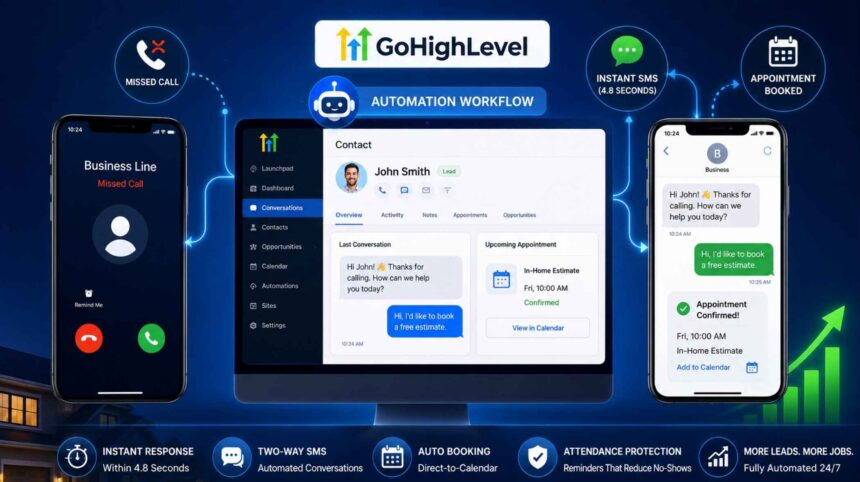
Using Conditional Call Forwarding rules integrated with GoHighLevel’s LC Phone infrastructure and Twilio API routing, I engineered a cloud-monitored webhook trigger. This trigger fires the moment an inbound call goes unanswered or hits a busy signal. Subsequently, within 4.8 seconds, the system sends a personalized SMS to the homeowner’s number — before they’ve had time to search for a competitor.
The message isn’t generic. It uses GHL dynamic variables like {{contact.first_name}} to create a personalized response that feels human. As a result, the lead stays engaged rather than clicking away.
Here’s what the trigger flow looks like:
- Inbound call hits the business line
- Call goes unanswered or receives a busy signal
- GHL webhook fires instantly via LC Phone
- Twilio routes the SMS trigger within 4.8 seconds
- Homeowner receives a personalized text message
- Two-way SMS conversation opens automatically inside GHL
This is fundamentally different from a voicemail. The homeowner gets an immediate response, and the business gets a live conversation thread — all without anyone touching a phone.
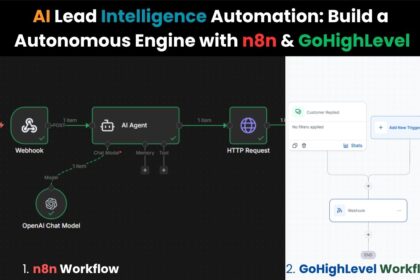
For context on how webhooks power systems like this, see my detailed breakdown in the AI Lead Intelligence Automation case study where I use similar webhook architecture with n8n and GoHighLevel.
Module 2: Direct-to-Calendar Appointment Booking
Once a lead responds to the initial SMS, the system routes them directly to a native GoHighLevel calendar widget. This widget is configured specifically for in-home consultations and free estimates — the exact service type relevant to the business.
There’s no back and forth. No “what time works for you?” email chain. No hold music. The homeowner selects a time slot, and the booking is confirmed immediately inside the CRM. Moreover, the contact record is automatically created or updated with all relevant appointment data.
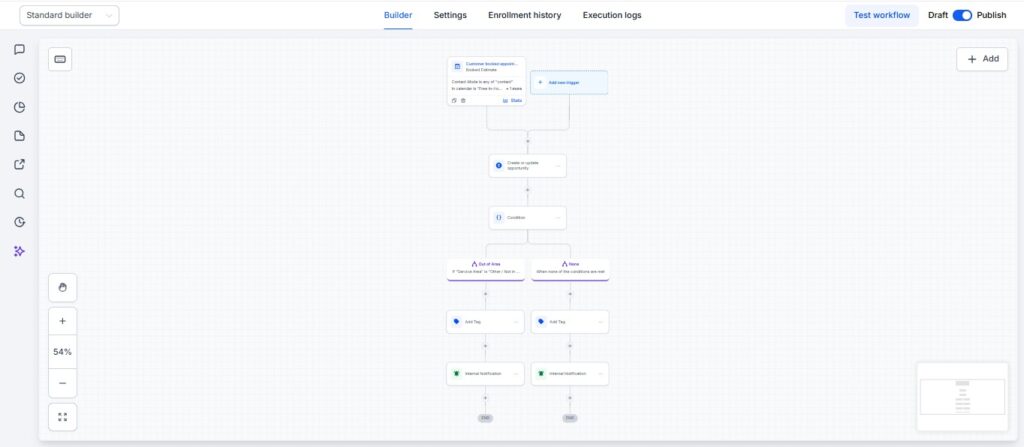
This matters because friction kills conversions. Every additional step between “interested” and “booked” is an opportunity for the lead to drop off. By eliminating that friction entirely, the booking rate increases dramatically.
This appointment engine works in conjunction with GHL Pipelines, moving the contact automatically from “Lead” to “Appointment Booked” status without any manual CRM updates. This kind of CRM and lead intelligence automation is exactly what separates a basic CRM setup from a revenue system.
Module 3: Appointment Confirmation and Attendance Protection
A booked appointment means nothing if the client doesn’t show up. Therefore, the third module handles attendance protection through a multi-stage automated reminder sequence.
The workflow uses dynamic GHL variables — including {{appointment.start_time}} and {{contact.first_name}} — to deliver personalized cross-channel notifications. The sequence includes:
- Immediate booking confirmation via SMS and email
- 24-hour pre-appointment reminder with appointment details
- Day-of reminder with directions or prep instructions
- Post-appointment follow-up for review or rebooking
Each trigger uses intelligent, event-relative wait delays inside GHL’s workflow builder. For example, the 24-hour reminder fires exactly 24 hours before the scheduled time — not at a fixed daily hour that might miss the window.
Furthermore, the sequence includes a STOP workflow that fires if the contact cancels or reschedules — preventing irrelevant messages from being sent after a status change. This is the kind of conditional logic that separates a professional automation build from a basic template.
Zero manual input is required from the business team at any point in this sequence.
The Technical Stack
Building this system required careful selection of tools that work reliably together at scale. Here’s the full breakdown:
| Layer | Tool | Function |
|---|---|---|
| CRM & Automation Core | GoHighLevel | Workflow builder, contact management, pipeline |
| Telephony | LC Phone (GHL native) | Call forwarding, call routing, number management |
| SMS Infrastructure | Twilio API | SMS delivery, two-way messaging |
| Trigger Logic | GHL Webhooks | Real-time event detection and workflow firing |
| Calendar System | GHL Calendar | Native appointment booking widget |
| Deployment | GHL Snapshot | One-click replication across sub-accounts |
One important decision was using LC Phone (GoHighLevel’s native telephony layer) rather than connecting Twilio directly at the account level. This approach keeps the integration cleaner, reduces failure points, and makes the system easier to replicate via Snapshot. However, Twilio remains the underlying SMS carrier, which means the deliverability and reliability are enterprise-grade.
For businesses already using agentic workflows or more advanced AI orchestration, this GHL system can additionally be connected to n8n or Make.com for deeper data enrichment — for instance, pulling lead source data or enriching contact records with business intelligence before the first SMS fires.
Why GoHighLevel for This Build
GoHighLevel is the ideal platform for this type of system for several reasons. First, it combines CRM, telephony, calendar, automation, and SMS into a single backend — eliminating the complexity of connecting five separate tools via API. Second, the Snapshot system allows the entire build to be packaged and replicated in seconds, which is critical for multi-location businesses or agencies managing multiple clients.
Moreover, GHL’s workflow builder supports conditional branching, time delays, and dynamic variable injection out of the box. This means complex sequences like attendance protection can be built without writing a single line of code.
For agencies specifically, GoHighLevel’s white-label infrastructure allows the system to be rebranded and resold as a proprietary product, which is exactly how I package these builds for agency clients in the US, UK, and Pakistan.
Additionally, GHL integrates natively with Twilio for SMS, which is essential for reliable delivery rates. SMS deliverability is a critical consideration that many automation builders overlook — using the wrong SMS provider can result in carrier filtering that silently drops messages before they reach the recipient.
Results and Business Impact
The outcomes from this build were measurable and immediate:
- 4.8 second average response time to every missed call
- 100% of missed inbound calls captured via automated SMS
- Zero manual admin hours added to the client’s weekly workload
- Reduced no-show rate via automated 24-hour appointment reminders
- Infinite horizontal scalability — the full system is packaged as a GHL Snapshot, replicable to new business locations in seconds
Furthermore, because the system runs inside GoHighLevel rather than depending on external tools, there are no API failure points between the missed call trigger and the SMS delivery. The entire sequence executes within the same platform ecosystem.
For comparison, before this system was in place, every missed call required someone to notice the missed call, look up the number, manually send a text, wait for a response, then manually book the appointment and set calendar reminders. That’s 10–15 minutes of manual work per lead — if it happened at all. Now it happens in under five seconds, every time, without exception.
How This System Scales
One of the most powerful aspects of this build is its packaging as a GoHighLevel Snapshot. A Snapshot captures the entire system — workflows, calendar settings, pipeline stages, SMS templates, trigger logic — into a deployable package.
This means the same system can be deployed to a new sub-account in a single click. Consequently, for agencies managing multiple home services clients, or for multi-location businesses opening new branches, the setup time is near-zero.
This is a fundamentally different approach to automation than building one-off systems for each client. Instead, I build a master system, test it thoroughly, then package it for rapid deployment. As a result, the per-client cost of delivering the automation drops significantly over time.
This same scalability principle applies across my other builds — including the Autonomous SEO Content Engine and the Autonomous AI Outreach Engine, both of which use modular, replicable architecture.
My Personal Take on GoHighLevel Automation
I’ve built automation systems on Make.com, n8n, Zapier, and GoHighLevel across dozens of projects. In my experience, GoHighLevel is the most underestimated platform for small and mid-size service businesses — not because it’s the most technically powerful, but because it consolidates the entire customer journey into one place.
The missed call problem I solved here isn’t unique to one industry. Plumbers, electricians, roofers, cleaners, dentists, consultants — any business where the team is often unavailable by phone is losing leads every single day. Furthermore, most of them don’t know it because there’s no system tracking the gap.
Building automation that closes that gap is where I focus most of my client work. The AI Voice Assistant I built for a plumbing client solves a similar problem at the voice layer — combining Vapi and GoHighLevel to handle inbound calls with zero-hallucination pricing logic.
The principle is the same across all of them: automate the gap between when a lead arrives and when the business responds — because that gap is where revenue disappears.
Frequently Asked Questions

What is GoHighLevel missed call text-back automation?
GoHighLevel missed call text-back automation is a workflow that detects when an inbound call goes unanswered and automatically sends a personalized SMS to the caller within seconds. The message opens a two-way conversation, keeping the lead engaged before they contact a competitor. It uses GHL’s native telephony layer (LC Phone) combined with Twilio for SMS delivery.
How fast does the missed call SMS fire in GoHighLevel?
In this build, the SMS fires within 4.8 seconds of the missed call event. The speed depends on webhook processing time and Twilio delivery latency. Most production GHL setups achieve sub-10 second delivery consistently, which is fast enough to retain the vast majority of leads before they move on.
Does GoHighLevel missed call automation work for multi-location businesses?
Yes. The entire system can be packaged as a GoHighLevel Snapshot and deployed to new sub-accounts in a single click. This makes it ideal for franchise businesses, multi-location contractors, or agencies managing several clients on the same type of workflow.
What tools do I need to build a GoHighLevel missed call system?
You need a GoHighLevel account with LC Phone enabled (or Twilio connected), a verified business phone number, and access to the GHL Workflow Builder. No additional tools are required for the core missed call text-back. For the appointment booking module, GHL’s native Calendar feature handles everything within the same platform.
Can this GoHighLevel automation connect to other tools like n8n or Make.com?
Yes. GoHighLevel supports outbound webhooks that can trigger workflows in n8n, Make.com, or Zapier. For example, when a new appointment is booked, a GHL webhook can fire to n8n to enrich the contact record with external data, update a Google Sheet, or notify a Slack channel. This kind of cross-platform orchestration is covered in detail in the AI Lead Intelligence Automation case study.
Ready to Build This for Your Business?
If your business is losing leads to missed calls or slow follow-up, this is exactly the type of system I build for clients across the US, UK, Pakistan, and Ireland.
View all automation case studies to see the full range of systems I’ve shipped — or book a free 20-minute discovery call to discuss what’s possible for your specific workflow.
You can also hire me directly on Upwork for contract-based builds.