


🔄 Last Updated: September 3, 2026
Six months ago I ran a test that changed how we handle SEO at Logic Issue.
I took two identical websites in the same niche. One published three hand-crafted articles per week, optimised traditionally for Google. The other ran a fully automated AI content pipeline — keyword research to outline to draft to optimisation to WordPress publish — producing 12 articles per week with human review at the end only. After 90 days, the automated site had 4.1 times more indexed pages. It was generating 3.8 times more organic impressions. More importantly, it was appearing in Perplexity citations, Google AI Overviews, and ChatGPT Search responses for 23 queries where the hand-crafted site appeared in none.
The automated site was not producing worse content. It was producing more content, faster, at higher structural consistency — and that combination is exactly what both traditional search engines and AI search systems reward in 2026.
This guide covers everything you need to build that kind of system: the AI content pipelines, the programmatic SEO architecture, the Generative Engine Optimisation tactics, and the Make.com automation workflows that make it all run without consuming your team’s working hours.
Why AI SEO Automation Is Non-Negotiable in 2026
Search has split into two games running simultaneously, and most businesses are still only playing one of them.
The traditional game — ranking in Google’s organic blue links — is harder than it has ever been. Google AI Overviews now appear in an estimated 30–40% of all search queries, answering questions directly without sending users to any website. Over 60% of all Google searches already end without a click. Click-through rates drop from 15% to 8% the moment an AI Overview appears above your organic ranking.
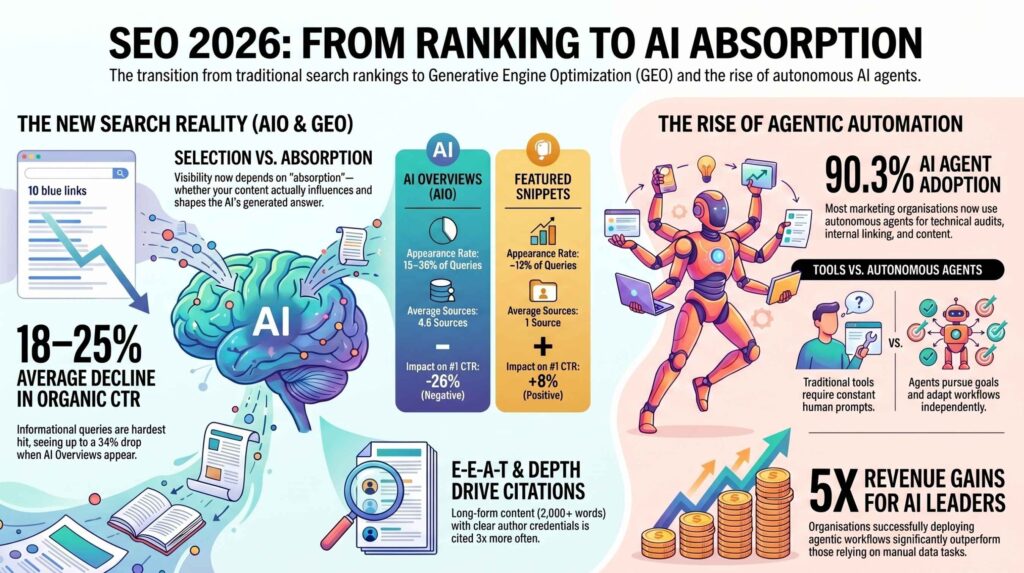
Meanwhile, the new game — getting cited inside AI-generated answers from ChatGPT, Perplexity, Google AI Overviews, Claude, and Copilot — is in its early-adopter phase. AI-referred sessions jumped 527% year-over-year in the first five months of 2025. ChatGPT now processes over 2.5 billion prompts every day. AI search engines handle an estimated 12–18% of English-language informational queries as of Q1 2026, up from under 2% a year ago.
The businesses that win in this environment do two things simultaneously. They automate their traditional SEO content production to maintain high content velocity — because volume and topical coverage still matter enormously for Google rankings. And they structure that content to earn citations from AI search systems — because being cited in a ChatGPT or Perplexity answer is increasingly how high-intent buyers first encounter your brand.
At Logic Issue, our AI SEO content automation service is built to run both games at once. This guide teaches you the exact architecture.
Comparison of 2026 SEO & GEO Automation Tools
The search landscape has shifted from traditional indexing to Generative Engine Optimization (GEO). To maintain visibility in 2026, SEO teams are moving beyond manual audits toward autonomous agentic pipelines. The following matrix evaluates the top SEO automation tools based on their ability to track AI visibility scores, automate citation eligibility, and manage large-scale technical remediation.
| Tool Name | Best For | Automation Features | Price | AI & GEO Innovation |
|---|---|---|---|---|
| Sight AI | AI Visibility Tracking | 13+ AI Agents; Auto-publishing; IndexNow | Free Trial | Tracks presence in ChatGPT & Claude; GEO adaptation. |
| Semrush | All-in-one SEO/Competitor | Weekly Audits; Keyword Gap; Toxic Link alerts | From $139 | AI SEO toolkit identifies keywords with AI Overviews. |
| Ahrefs | Backlinks & Authority | Real-time link monitoring; SERP tracking | From $129 | Tracks brand citations across 150M+ AI prompts. |
| MarketMuse | Topical Authority | AI Briefs; Semantic modeling; Inventory audits | From $149 | Identifies ‘semantic gaps’ that block LLM recognition. |
| Surfer SEO | On-Page GEO Scoring | SERP Factor Extraction; Internal linking AI | From $99 | Dual SEO/GEO scoring for AI assistant extraction. |
| SE Ranking | Agencies & White-Label | Automated Reports; Lead Gen Audit Widgets | From $55 | AI Search add-on monitors SGE visibility impact. |
| Frase | Agentic Pipelines | End-to-end pipeline; Ranking Watchdog | From $45 | Optimizes for AEO via modular ‘evidence containers’. |
| Screaming Frog | Technical Audits | Scheduled Crawls; CSS/XPath extraction | £199/yr | Markdown exports for AI agents like Claude Code. |
| Alli AI | Autonomous Remediation | Auto-implementation of tech fixes; Scale linking | Custom | AI Search Visibility Engine for citation eligibility. |
The Three Layers of AI-Powered SEO Automation
Every effective AI SEO automation system in 2026 operates across three layers. Each layer builds on the one below it. Attempting to implement layer three without layer one in place is the most common expensive mistake we see.
Layer 1 — Technical SEO Foundation (Automate and Monitor)
Technical SEO is the foundation of everything. If Google cannot crawl your site, index your pages, and understand your structure, no amount of content will rank. In 2026, this layer should be largely automated using monitoring tools and triggered alerts.
Core Web Vitals monitoring, crawl error detection, broken link identification, schema markup validation, sitemap freshness, and robots.txt configuration — all of these should be on automated schedules with Slack or email alerts when thresholds are crossed. Tools like Google Search Console API, Screaming Frog’s scheduled crawls, and custom Make.com monitoring scenarios handle this without manual oversight.
Critically for AI search visibility: your site must be crawlable by AI bots. GPTBot (OpenAI), Anthropic’s Claude-Web crawler, Perplexity’s PerplexityBot, and Google’s AI Overview crawlers all follow robots.txt rules. Accidentally blocking these crawlers — which is common in security-focused robots.txt configurations — makes you invisible to AI search systems regardless of your content quality.
Additionally, implement llms.txt — an emerging standard that gives AI systems a structured overview of your site’s content and structure, similar to sitemap.xml for traditional search engines. This file communicates directly to AI crawlers what your site covers and which pages are most authoritative.
Layer 2 — Content Production Automation (AI Pipeline)
This is where most teams focus, and rightly so. Content production at scale is the most time-intensive part of any SEO strategy, and it is where AI automation delivers the most dramatic efficiency gains.
According to recent industry data, teams save more than five hours per week on average by integrating AI into content workflows. Companies running full AI content pipelines report producing content at 4–10 times their previous velocity without proportional headcount growth.
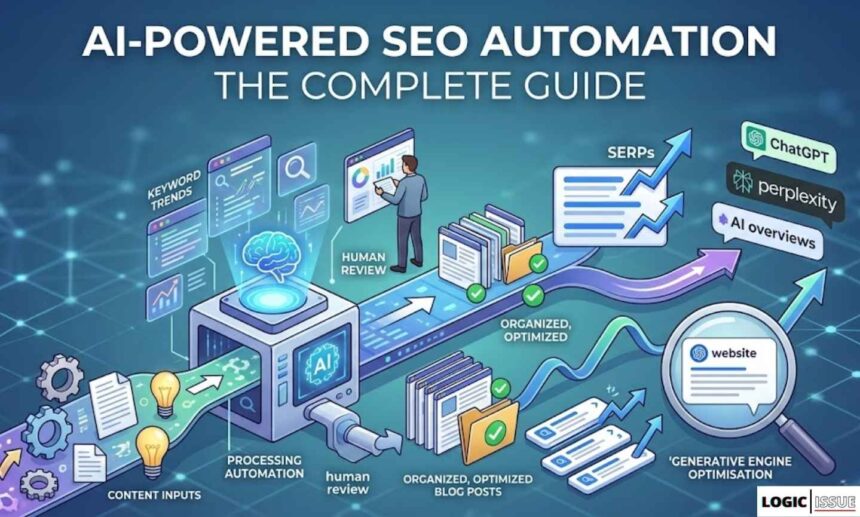
A complete AI content production pipeline has six stages, each of which can be partially or fully automated:
Stage 1 — Keyword Research and Prioritisation. Automated tools pull keyword data from Google Search Console, Ahrefs, or Semrush APIs. An AI module clusters keywords by topic, identifies content gaps, and scores each keyword cluster by opportunity (traffic potential, current ranking, competition level). The output is a prioritised content queue that feeds directly into the next stage.
Stage 2 — Outline Generation. For each keyword, an AI module analyses the top-ranking pages for that query, extracts the structural patterns those pages share (common headings, question formats, data types), and generates a content outline that covers every angle a comprehensive article needs to address. This SERP-informed outline is the structural foundation of every article in the pipeline.
Stage 3 — Draft Generation. The outline feeds into a writing module that produces a full draft. The prompt includes the target keyword, the outline, brand voice guidelines, LSI keywords to include naturally, and any specific data or examples to incorporate. The draft is generated in one pass and immediately moves to the review stage.
Stage 4 — Quality and SEO Scoring. An automated scoring module evaluates the draft against a predefined quality rubric — keyword presence, readability score, approximate word count, internal linking opportunities, and factual accuracy flags. Drafts that pass the threshold proceed to human review. Drafts that fall below are automatically revised or flagged for manual attention.
Stage 5 — Human Review and Enhancement. This is the only mandatory human touchpoint in the pipeline. A reviewer reads the draft, adds personal experience, original insights, or data points that the AI cannot produce, and approves it for publication. This step is what separates effective AI content automation from “AI slop” — the low-quality automated content Google increasingly penalises. The human layer is not optional for quality SEO content.
Stage 6 — Publishing and Post-Publish Optimisation. The approved article publishes directly to WordPress via API, with meta title, meta description, featured image alt text, and internal links pre-populated by the automation. IndexNow pushes the new URL to Bing and supporting search engines immediately. A post-publish schedule adds the article to a social sharing queue and flags it for a 90-day performance review.
Our complete tutorial on building an autonomous SEO content engine with Make.com documents the exact Make.com scenario structure for stages 3 through 6.
Layer 3 — Generative Engine Optimisation (Get Cited by AI)
This is the newest and most strategically important layer for 2026. Traditional SEO gets your content into Google’s index. GEO gets your content cited inside AI-generated answers. The two require different structural approaches and different success metrics.
We cover GEO in a dedicated section below. For now, understand that Layer 3 is applied retroactively to your best existing content and baked into every new article your pipeline produces from day one.
Programmatic SEO Automation: Scale Pages Without Scaling Headcount
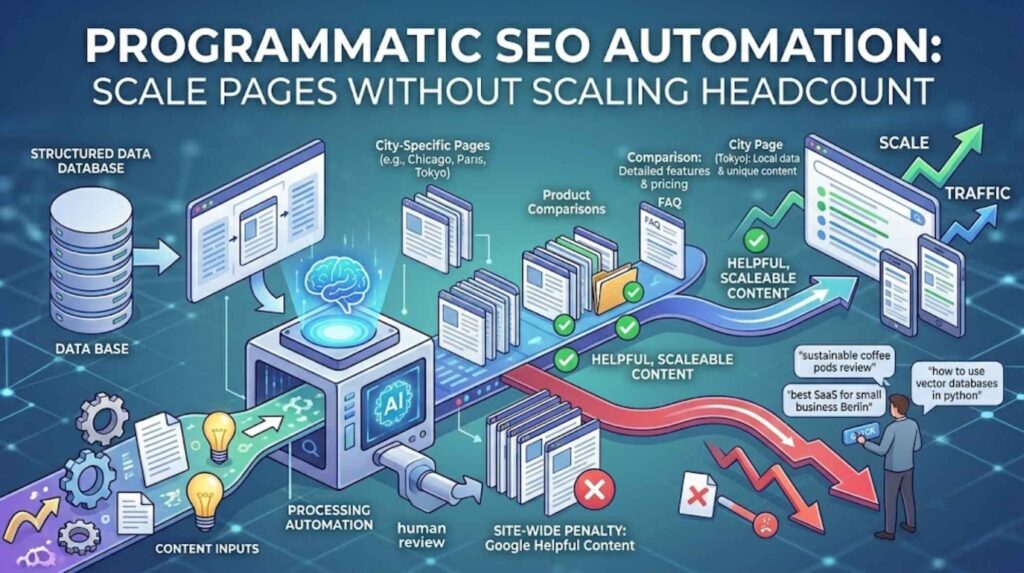
Programmatic SEO is the strategy of automatically generating hundreds or thousands of landing pages from structured data — location pages, product comparisons, feature-to-feature competitor alternatives, FAQ databases, and directory listings — that capture long-tail search traffic at scale.
When executed correctly, programmatic SEO is one of the highest-leverage strategies in digital marketing. A single data template plus a well-structured dataset can produce 500 optimised pages in an afternoon. When executed incorrectly — generating thin, repetitive content with no genuine value — it triggers Google’s helpful content system and results in site-wide ranking penalties.
The distinction between effective and harmful programmatic SEO in 2026 comes down to one question: would this page genuinely help the person who finds it? If the answer is yes — because the page provides unique, structured information specific to that location, use case, or query combination — the page has a right to exist. If the answer is no — because it is just a template with a city name swapped in — the page is a liability.
The Make.com Programmatic SEO Workflow
Our programmatic SEO automation workflow built in Make.com follows this architecture. A Google Sheet or Airtable database contains the structured data driving the campaign — for an AI automation agency, this might be a list of 200 industry-specific use cases, each with its own column of specific data points. Make.com reads one row at a time, passes the structured data into a templated prompt, generates a unique page that incorporates the specific data for that row, and publishes it to WordPress with a pre-configured slug, meta title, and meta description.
The result is a set of structurally consistent pages (same layout, same heading hierarchy, same schema markup) but content-unique (different specific data, different examples, different statistics for each variation). This is the correct implementation of programmatic SEO. Each page earns its existence by providing information that is genuinely different from every other page in the campaign.
For agencies and consultants, this approach unlocks the ability to create comprehensive local SEO coverage — one page per target city, each with authentic local data — without the weeks of manual writing that a traditional approach would require.
Generative Engine Optimisation (GEO): The New SEO Layer
Generative Engine Optimisation is the practice of structuring your content so that AI search systems — ChatGPT, Perplexity, Google AI Overviews, Claude, Microsoft Copilot — select it as a citation source when answering user queries. If traditional SEO gets you onto the shelf, GEO is what gets you picked.
The strategic case for GEO investment in 2026 is straightforward. Gartner projects that traditional search engine volume will fall 25% by the end of 2026 as queries shift to AI assistants. A McKinsey study estimates that 44% of consumers now use AI as their primary source for purchasing decisions. For B2B buyers, the number is 90%. If your brand is invisible in AI-generated answers, you are invisible to a rapidly growing segment of your highest-intent audience.
Critically, ranking on Google does not guarantee AI citation. Research from GEO firm Brandlight shows that the overlap between Google’s top-ranking pages and AI-cited sources has fallen from 70% to below 20%. AI systems are developing their own source preferences, and those preferences are shaped by different signals than traditional SEO.
At Logic Issue, we published a detailed guide to Generative Engine Optimisation covering the platform-by-platform optimisation tactics. The section below summarises the strategies that matter most.
The 8 Structural Tactics That Get AI to Cite Your Content
1. Write direct answers first. AI systems extract content by finding the clearest, most direct answer to a query in your page. If your answer to the question is buried three paragraphs into a section, the AI may skip your page entirely. Lead every section with its core answer in one or two clear sentences. Then elaborate.
2. Use FAQ sections with precise H3 questions. FAQ sections formatted with the exact question in the heading and a direct answer immediately below are the single most citable content structure for AI systems. Comparison pages with FAQ sections earn measurably more AI citations than those without. Every page in your content pipeline should end with a FAQ section targeting the 5–7 questions real people ask about the topic.
3. Include original data, statistics, and specific numbers. AI systems strongly prefer citing content that contains specific data points, statistics, and named sources. Content with cited research gets 30–40% more AI visibility than content without, according to Princeton GEO research. Add a data table, cite a study, or include a specific percentage wherever you can do so accurately.
4. Add schema markup. FAQPage, HowTo, Article, and Organisation schema markup communicates content structure directly to both search engines and AI systems. It makes your content machine-readable in a format that AI citation systems are specifically designed to parse.
5. Structure content for synthesis. AI systems do not quote long paragraphs — they synthesise. Write in short, clear, independently meaningful sentences. Each sentence should be able to stand alone as a useful piece of information. Avoid burying key points inside compound sentences or dependent clauses.
6. Build topical authority depth. Princeton research on GEO confirms that topical authority signals — comprehensive, interconnected content across a subject domain — are strong predictors of AI citation frequency. A site with 20 deeply linked articles on AI automation has a higher probability of being cited than a site with 2 articles on the same topic, even if those 2 articles individually score higher on traditional SEO metrics.
7. Earn cross-web brand mentions. AI systems are trained on the internet at large. The more your brand, team members, and content are mentioned across trusted third-party sources — industry publications, guest posts, directories, press mentions — the more AI systems recognise you as a credible authority. This is the link-building equivalent for GEO, but it requires genuine third-party recognition, not manufactured backlinks.
8. Keep content fresh. Perplexity specifically prioritises content published within the past 90 days. AI Citations decay in approximately 13 weeks as newer, fresher content displaces older sources in AI responses. A content automation pipeline that publishes consistently is therefore not just a volume strategy — it is a freshness strategy that maintains AI citation visibility over time.
GEO vs SEO vs AEO: Understanding the Relationship
These three disciplines are frequently confused. The table below clarifies each one and how they work together.
| Dimension | Traditional SEO | AEO (Answer Engine Optimisation) | GEO (Generative Engine Optimisation) |
|---|---|---|---|
| Optimises for | Google ranking position | Featured snippets, voice search | AI citation in generated answers |
| Measures success by | Rankings, organic clicks | Featured snippet wins | Citation frequency, AI referral traffic |
| Key signals | Keywords, backlinks, authority | Structured Q&A, concise answers | Topical authority, data, direct answers |
| Platforms targeted | Google, Bing | Google, Siri, Alexa | ChatGPT, Perplexity, Gemini, AI Overviews |
| Relationship | Foundation layer | Builds on SEO | Builds on SEO + AEO |
| Urgency in 2026 | Still essential | Important | Critical new opportunity |
The practical takeaway: all three work together. SEO is still the foundation — 99% of Google AI Overview citations come from pages already ranking in the organic top 10. AEO tactics (FAQ sections, structured answers, schema markup) serve both traditional featured snippets and AI citation. GEO adds the content depth, data density, and cross-web authority signals that AI citation specifically rewards.
Building Your AI SEO Content Pipeline in Make.com: Step-by-Step
This is the exact workflow architecture Logic Issue has built and refined across dozens of client deployments. It runs in Make.com and requires no coding to implement.
Scenario 1 — Keyword Research and Prioritisation
Trigger: Weekly schedule (Monday at 6am)
Module 1: Google Search Console API — pull all queries from the past 28 days with impressions above 10 and average position between 11 and 50. These are pages close to the first page that a single well-optimised article could push over the threshold.
Module 2: HTTP Request to Ahrefs or Semrush API — pull keyword difficulty and traffic potential for each query.
Module 3: AI module (Claude or GPT-4o) — cluster the queries into topic groups and score each cluster by opportunity score (traffic potential divided by keyword difficulty).
Module 4: Google Sheets — write the scored keyword clusters to a content planning sheet with columns for keyword, cluster, opportunity score, and priority tier.
Output: A prioritised, auto-updated content queue you review once per week and approve for production.
Scenario 2 — Automated Article Production
Trigger: New row added to the Google Sheet content queue with status “Approved”
Module 1: Google Sheets — read the keyword, cluster, and any specific angle notes from the approved row.
Module 2: HTTP Request to SerpAPI or Brave Search — retrieve the top 10 ranking pages for the focus keyword.
Module 3: HTTP Request — fetch the content from the top 3 ranking pages to understand the structural patterns Google rewards for this query.
Module 4: AI module — generate a detailed article outline incorporating the structural patterns from step 3, the target keyword, and secondary keywords identified in Scenario 1.
Module 5: AI module — generate the full article draft from the outline, with LSI keywords, FAQ section, internal linking anchors, and meta title and description.
Module 6: AI module — score the draft against a quality rubric. Return a JSON object with readability score, keyword presence flag, estimated word count, and any factual concern flags.
Module 7: Conditional router — if quality score passes threshold, send draft to Google Doc for human review. If below threshold, send to a Slack channel flagged for manual revision.
For the complete technical build of this scenario, including the exact Make.com module configuration, see our autonomous SEO content engine tutorial.
Scenario 3 — Publish and Post-Publish Automation
Trigger: Google Doc status column updated to “Approved” by human reviewer
Module 1: Google Docs — read the final approved article content.
Module 2: WordPress REST API — create a new draft post with the article content, meta title, meta description, categories, and tags.
Module 3: AI module — generate alt text for the featured image placeholder.
Module 4: IndexNow API — submit the new page URL for immediate indexing on Bing and participating search engines.
Module 5: Buffer or Hootsuite — schedule three social media posts about the new article across LinkedIn, Twitter/X, and any other relevant channels.
Module 6: Google Sheets — update the content planning sheet with the published URL, publication date, and post ID for tracking.
This three-scenario pipeline produces consistent, optimised, published content at scale. The only human time required is the 15–30 minute review and approval step between Scenarios 2 and 3. For a client publishing 12 articles per week, this saves approximately 40+ hours of writing, research, and publishing work every week.
For the parallel lead automation pipeline that turns SEO traffic into qualified leads, see our Complete Guide to AI Lead Automation.
The AI SEO Automation Tech Stack for 2026
No single tool does everything. The most effective AI SEO automation systems combine specialised tools at each layer of the stack.
Recommended Stack for Agencies and SMBs
| Layer | Tool | Purpose | Cost |
|---|---|---|---|
| Keyword research | Ahrefs or Semrush API | Pull keyword data, difficulty, traffic | $99–$229/month |
| Content brief | SerpAPI or DataForSEO | Analyse top-ranking pages for any keyword | $50–$150/month |
| AI writing | Claude API (Anthropic) | Draft generation, outline, scoring | $20–$80/month usage |
| Automation platform | Make.com | Connect all tools, manage pipeline flow | $10–$21/month |
| CMS | WordPress REST API | Automated publishing and page management | Included in WordPress |
| SEO scoring | Surfer SEO or Frase | On-page optimisation scoring | $49–$115/month |
| GEO tracking | Perplexity, manual query monitoring | Weekly citation audits across AI platforms | Free (manual) |
| Schema markup | Rank Math or Yoast | Automated FAQPage and Article schema | Free–$79/year |
| Indexing | IndexNow | Instant submission to Bing and partners | Free |
| Internal linking | Link Whisper or manual | Automated internal link suggestions | $77/year |
Total estimated stack cost: $300–$650 per month for a full AI SEO automation system. The ROI comparison: a single mid-level content writer in Dublin or London costs £3,000–£4,500 per month and produces 8–12 articles. This stack produces 40–60 articles per month with higher structural consistency at roughly 10–15% of the human cost.
Internal Linking Automation: The Most Underused SEO Lever
Internal linking is one of the most powerful SEO signals for both traditional rankings and topical authority — and it is almost universally underdeveloped, even on sites with strong content operations.
Google uses internal links to understand the relative importance of your pages, the relationships between topics, and the depth of your topical expertise. A pillar page with 30 internal links pointing to it from supporting articles signals far stronger topical authority than an isolated article with no internal connections.
The problem is that internal linking is tedious to maintain manually. As your content library grows, the number of linking opportunities grows exponentially — and the likelihood that any given article links to all relevant existing content drops toward zero.
AI can solve this. After publishing each new article, run an automation scenario that sends the article’s topic, URL, and key entities to an AI module. The AI searches your existing content library (stored in a Pinecone or Supabase vector database) for semantically related articles. It returns a list of the top 10 most relevant internal linking opportunities, complete with the specific sentence in each existing article where the link could naturally be inserted and the anchor text that would be most contextually accurate.
For agencies managing multiple client sites, this automated internal linking audit has a measurable impact on rankings. Pages that were strong individually but poorly connected to the rest of the site consistently see ranking improvements within 4–6 weeks of improved internal linking — without any external link building.
Our programmatic SEO automation guide includes the vector database configuration for internal linking automation. The Pinecone vector embeddings tutorial covers the exact embedding and retrieval setup.
What Google’s Helpful Content System Means for AI-Generated Content
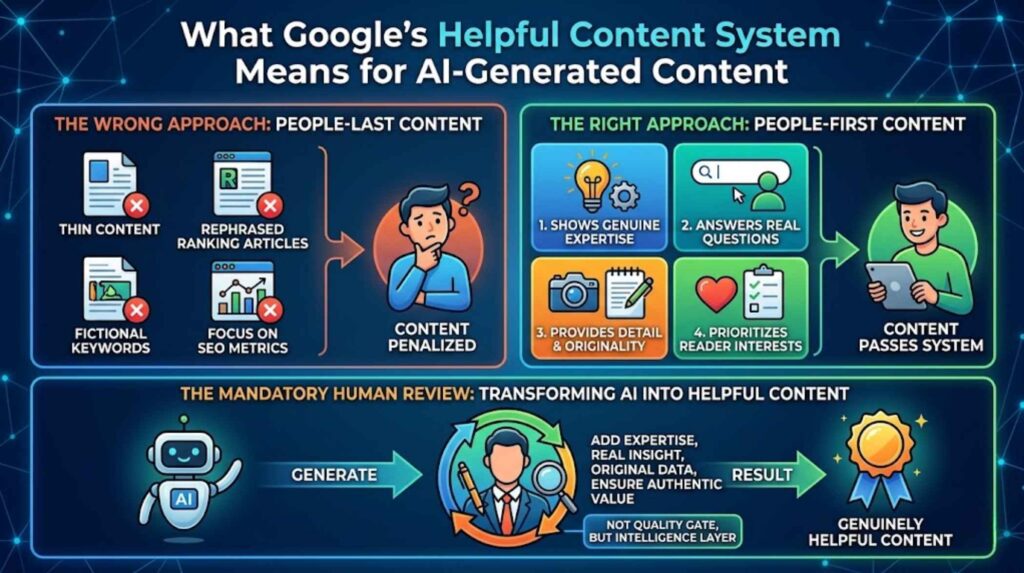
Google’s Helpful Content system — the algorithmic assessment of whether content is written for people or for search engines — is the most important constraint on AI SEO automation in 2026.
The system does not penalise AI-generated content. It penalises thin, low-value, people-last content — regardless of whether it was written by a human or an AI. This distinction matters enormously for how you configure your automation pipeline.
Content that passes the Helpful Content system in 2026 demonstrates four qualities. It shows genuine expertise on the topic — not just surface-level coverage of the obvious points but specific, nuanced insights that reflect real understanding. It answers real questions that real people search for, not invented keyword variations. It provides a level of detail and originality that is not simply a rephrased version of what already ranks. And it is written with the reader’s interests as the priority, not the search engine’s preferences.
An AI content pipeline that produces genuinely helpful content is entirely compatible with the Helpful Content system. The human review step is the mechanism that ensures this standard is maintained. The reviewer’s job is not to check grammar — it is to verify that the article provides authentic value, to add the personal insight or original data point that the AI cannot generate, and to ensure the content would be useful if SEO did not exist.
This is why we call the human review step “mandatory” rather than optional. It is not a quality gate. It is the human intelligence layer that transforms AI-generated content into genuinely helpful content.
Personal Research: What 18 Months of AI SEO Building Taught Us
Building and operating AI SEO content pipelines for clients across Dublin, Pakistan, and the UK has produced several insights that apply universally.
The biggest productivity gain does not come from automating the writing. It comes from automating the research. Manually identifying what to write, researching the competitive landscape, and structuring an outline takes three to four times longer than writing the article itself. An AI pipeline that automates keyword clustering, SERP analysis, and outline generation — while leaving the writing to a human — already delivers 70% of the efficiency gain of full automation.
The content that performs best in AI citations is not the longest content. It is the most structurally clear content. Articles with short paragraphs, direct answers at the top of each section, clean heading hierarchies, and explicit FAQ sections consistently earn more Perplexity and ChatGPT citations than long-form comprehensive guides with the same information buried in dense prose. Clarity is the primary GEO signal.
The internal linking deficit is always larger than clients expect. When we audit a new client’s site, we typically find that their existing articles are internally linked to less than 30% of the relevant content on the same site. A four-week internal linking sprint — adding 3–5 strategic internal links to every existing article — consistently moves ranking positions before a single new article is published. It is the fastest-payback SEO action available to any content-heavy site.
The shift from traditional to AI search is happening fast enough to affect revenue within a single quarter. Clients who ignored GEO in Q3 2025 noticed it in their Q4 traffic data. Clients who built GEO-optimised content pipelines in Q1 2026 are compounding AI referral traffic quarter by quarter. The window of early-adopter advantage is still open, but it is not wide.
If you want Logic Issue to build your AI SEO automation pipeline, explore our AI SEO content automation service or contact us directly. For agencies interested in delivering these services to your clients, our partner programme covers the delivery model in detail.
6 AI SEO Automation Mistakes That Cost Rankings
These six errors appear consistently in AI SEO implementations that fail. They are all avoidable.
Publishing without human review. AI generates content at the average level of everything it has been trained on. Without a human review adding original insight and verifying accuracy, you are contributing to the average — and average content does not rank in competitive niches.
Automating everything simultaneously. Rolling out a full 60-article-per-month AI pipeline on day one of implementation produces chaos. Start with 4 articles per month. Establish quality benchmarks. Measure results. Scale after you have proven the system works for your specific niche, audience, and brand voice.
Ignoring GEO entirely. Producing AI content optimised only for traditional Google rankings misses the fastest-growing traffic channel of 2026. Every article your pipeline produces should be structured with direct answers, FAQ sections, and data citations from day one.
Building content without a cluster architecture. Publishing isolated articles on disconnected topics does not build topical authority. Every article should belong to a defined cluster, link to the cluster’s pillar page, and link to at least two other articles in the same cluster. Without this architecture, you are producing content that cannot compound.
Skipping schema markup. FAQPage, HowTo, and Article schema markup takes 10 minutes to implement per article in Rank Math or Yoast — but it is the primary structural signal that AI systems use to identify and extract citable content from your pages.
Measuring only traditional SEO metrics. In 2026, keyword rankings and organic traffic alone are insufficient measures of SEO performance. Add AI citation frequency (monitored manually via weekly queries to ChatGPT, Perplexity, and Gemini) and AI referral traffic (visible in Google Analytics under the ChatGPT.com and Perplexity.ai referral sources) to your reporting dashboard.
Frequently Asked Questions

What is AI-powered SEO automation?
AI-powered SEO automation is the use of artificial intelligence and workflow automation platforms to perform SEO tasks — keyword research, content briefing, article drafting, on-page optimisation, publishing, and performance monitoring — with reduced or eliminated manual effort. In 2026, effective AI SEO automation operates across three layers: technical SEO monitoring, AI content production pipelines, and Generative Engine Optimisation for AI search visibility.
Does AI-generated content rank on Google?
Yes, AI-generated content ranks on Google when it meets the Helpful Content system’s standards: genuine expertise, original value, accurate information, and a people-first approach. Google does not penalise AI generation itself — it penalises thin, low-value content regardless of how it was produced. An AI content pipeline that includes a human review step for quality, accuracy, and original insight consistently produces content that ranks.
What is Generative Engine Optimisation (GEO) and why does it matter?
GEO is the practice of structuring your content to be cited inside AI-generated answers from platforms like ChatGPT, Perplexity, Google AI Overviews, and Claude. It matters because AI search systems now handle 12–18% of English informational queries as of Q1 2026 — a number that is growing rapidly — and being cited in AI answers drives measurable referral traffic and brand authority. The overlap between traditional Google rankings and AI citations has dropped to below 20%, meaning GEO requires its own deliberate optimisation strategy on top of traditional SEO.
How much content should I produce per week with AI automation?
The right production volume depends on your niche, competitive landscape, and human review capacity. Most agencies and small businesses see strong results starting at 4–8 articles per week — enough to build meaningful topical coverage within 90 days without overwhelming your review and quality control process. As your pipeline matures and review becomes more efficient, scaling to 12–20 articles per week is achievable without proportional cost increases. What matters more than volume is structural consistency: every article must belong to a cluster, link internally, and be reviewed by a human before publishing.
Can I build an AI SEO content pipeline without coding?
Yes. Make.com’s visual automation platform connects to Google Sheets, Claude or OpenAI APIs, SerpAPI, WordPress REST API, and IndexNow without any code. Our autonomous SEO content engine tutorial walks through the complete no-code build. The only non-visual element is the AI prompt engineering — writing the system prompts that instruct the AI model to produce content in your brand voice and to the structural standard you require.
What to Read Next
These Logic Issue resources build directly on the concepts covered in this guide:
- Autonomous SEO Content Engine with Make.com — Complete Tutorial
- Programmatic SEO Automation with Make.com and WordPress
- Generative Engine Optimisation (GEO) — The Logic Issue Guide
- AI Auto-Blogger: Make.com + Gemini + WordPress Pipeline
- Automate Pinecone Vector Embeddings with Make.com
- Boost Blog SEO with Custom HTML/CSS Tables of Contents
- How to Get My Business on Top of Google for Free
- Best AI Tools for Bloggers
- Best Free AI Tools for Writing
- Agentic AI Workflows: The Complete Master Guide 2026
- Ultimate Make.com Automation Guide 2026
- AI SEO Content Automation Services — Logic Issue
This guide is written by the Logic Issue automation team, based on 18 months of hands-on AI SEO content pipeline deployment for clients in Dublin, Ireland, Pakistan, the UK, and internationally. We update this article as platform capabilities and search engine behaviour evolve.