


🔄 Last Updated: August 31, 2026
The search landscape is undergoing a massive transformation. As generative AI systems replace traditional search engine results pages (SERPs) with synthesized, conversational answers, marketers must adapt their strategies to remain discoverable. Enter Generative Engine Optimization (GEO)-the new frontier of digital visibility.
Unlike traditional ranking tactics, GEO centers on authority, context, and machine readability. It requires brands to structure information so AI models (like Google’s AI Overviews, ChatGPT, and Perplexity) can seamlessly interpret, trust, and surface it in their responses.
This shift is no longer theoretical. AI-powered engines are already influencing purchasing decisions, brand perception, and content discovery. Understanding GEO today gives businesses a critical competitive edge for tomorrow.
What Is Generative Engine Optimization (GEO)?
Generative Engine Optimization is the practice of optimizing digital content specifically for AI-powered generative search engines. Instead of solely targeting “ten blue links,” GEO aims to position your brand as a cited source inside AI-generated answers.
These engines analyze massive datasets, extract key insights, and deliver summarized responses to user queries. To get noticed by them, your content must prioritize semantic clarity and topical authority.
AI systems don’t simply match keywords; they evaluate the relationships between concepts, look for credibility signals, and rely heavily on structured data. This means your content must demonstrate measurable expertise and factual consistency. If your brand isn’t structured for citation, it becomes invisible within the AI’s selected narrative.
Traditional SEO vs. GEO: What’s the Difference?
GEO differs from traditional SEO in both mechanics and measurement. While traditional SEO optimizes for rankings on a search page, GEO optimizes for inclusion within an AI-generated summary.
Classic SEO depends heavily on keyword targeting and backlinks. In contrast, generative optimization weighs contextual depth, topical clusters, entity associations, and factual consistency.
Here is a quick breakdown of how the two compare:
| Feature | Traditional SEO | Generative Engine Optimization (GEO) |
| Primary Goal | Rank position #1 on the SERP | Appear as a cited source in AI answers |
| Keyword Strategy | Exact-match and long-tail targeting | Semantic relevance and contextual depth |
| Success Metrics | Click-through rates (CTR), rankings, traffic | Citation frequency, AI brand mentions, engagement |
| Content Structure | Optimized pages for web crawlers | Structured, machine-readable knowledge graphs |
| User Journey | Click-through based (visiting multiple sites) | Zero-click, answer-based (staying on the search engine) |
In classic SEO, being in position one meant maximum exposure. In generative environments, only cited or referenced sources gain recognition. If the AI response summarizes your competitor’s insight instead of yours, traditional rankings become irrelevant.
A Framework for GEO: Strategy, Structure, and Metrics
Succeeding in GEO requires a framework that blends content strategy with technical precision. AI models favor authoritative domains, highly structured data, and consistent topical coverage.
1. Topical Depth over Isolated Keywords
Strategy starts with depth. Rather than producing isolated, keyword-driven blog posts, brands must create interconnected content hubs. Topic clusters help AI systems understand subject relationships. Ensure each cluster includes a “pillar” piece of content supported by detailed subtopics that reinforce your brand’s expertise.
2. Machine-Readable Structure
Content must be incredibly easy for machines to parse. To improve the likelihood of being cited in summaries, use:
- Clear, descriptive H2 and H3 headings
- Bullet points for easy extraction
- Direct, concise definitions (e.g., “GEO is…”)
- Schema markup and FAQ sections
3. Evolving Your KPIs
Traditional analytics tools won’t show the full impact of GEO, especially as zero-click searches increase. Instead, track:
- Brand mentions within AI-generated responses
- Increases in branded search queries
- Direct traffic growth
- Engagement depth from AI-assisted discovery
What GEO Looks Like in Practice
In practice, GEO involves building content ecosystems that answer layered, complex questions. Instead of writing one article per keyword, you design a knowledge framework.
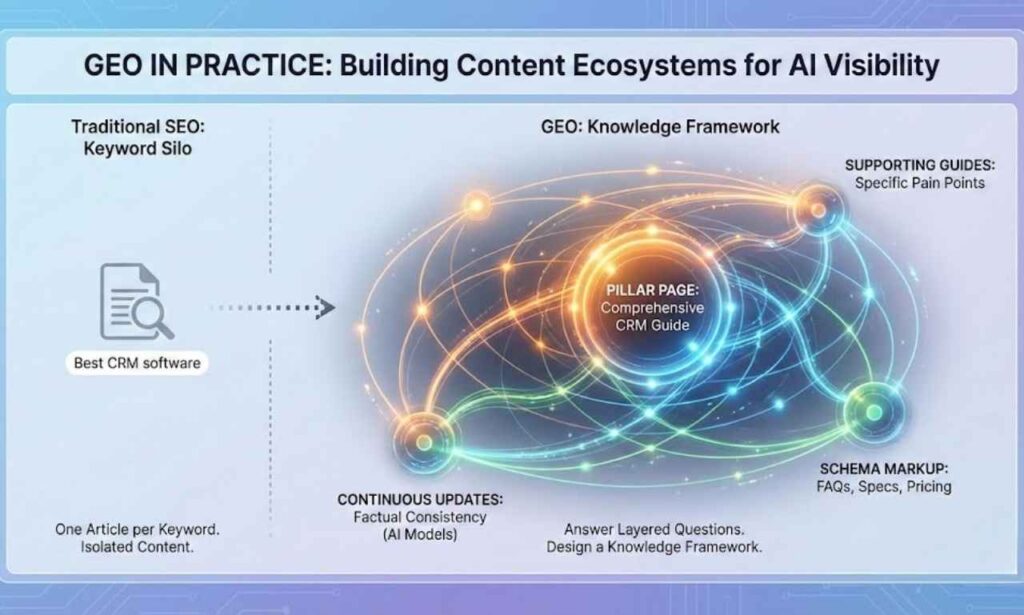
For example, a SaaS company optimizing for AI visibility shouldn’t just write a blog post about “Best CRM software.” Instead, they would:
- Develop a comprehensive pillar page on customer relationship management.
- Publish supporting guides addressing highly specific user pain points.
- Implement schema markup for FAQs, product specs, and pricing.
- Continuously update older content to maintain factual consistency (AI models heavily penalize outdated statistics).
How to Implement Generative Engine Optimization
Ready to optimize your site for AI search? Follow these core steps:
- Map Topic Clusters: Identify primary themes and break them down into subtopics. Link them logically to create semantic reinforcement.
- Anticipate Follow-Up Questions: AI engines process conversational queries. Your content must anticipate what a user will ask next and provide layered answers within a single resource.
- Optimize Formatting: Avoid vague, flowery language. AI engines prefer direct explanations and well-supported claims. Use bold text for key terms and organized paragraphs.
- Implement Structured Data: Use Schema markup (JSON-LD) for articles, FAQs, and reviews. This enhances extraction accuracy for Large Language Models (LLMs).
- Monitor and Iterate: Track branded searches and traffic patterns. GEO requires continuous refinement to strengthen your inclusion probability over time.
Will GEO Replace SEO?
No, GEO will not replace SEO—it will expand it. Traditional SEO still governs the baseline rules of the internet: crawlability, indexing, site speed, and technical performance. Without a strong technical foundation, GEO cannot succeed.
However, GEO shifts the ultimate focus from ranking to recognition. SEO ensures your site can be found; GEO ensures your site is cited within AI-generated narratives. Businesses that ignore GEO risk fading into obscurity as AI-generated answers dominate the user experience. The future of search is a hybrid approach.
Conclusion
Generative Engine Optimization is not a passing trend; it is a structural change in how information is surfaced, summarized, and trusted online. As AI-generated search experiences become the standard, brands must pivot from chasing clicks to building structured knowledge ecosystems. Businesses that begin optimizing for GEO now will build long-term authority, while those who delay may find themselves summarized right out of relevance.
FAQs

What is Generative Engine Optimization (GEO)?
Generative Engine Optimization (GEO) is the process of optimizing digital content so AI-powered search engines can cite, summarize, and include it within generated answers, rather than just ranking it on a traditional search results page.
How is GEO different from SEO?
GEO focuses on AI-generated summaries and citation visibility, emphasizing semantic clarity, authority signals, and structured data. Traditional SEO focuses on keyword placement and backlinks to rank web pages in standard search results.
Why is Generative Engine Optimization (GEO) important right now?
As AI-generated answers (like Google’s AI Overviews) increasingly replace traditional links, brands must optimize for inclusion within those responses to maintain visibility in zero-click search environments.
Does GEO require technical changes to a website?
Yes. GEO often requires technical upgrades like structured data (Schema) implementation, improved content architecture, and stronger topical clustering to help AI systems accurately interpret your information.
Can small businesses benefit from GEO?
Absolutely. Small businesses can compete effectively in AI search by building deep niche authority, producing clear expert content, and structuring their information efficiently for AI-driven systems.
See Also: Best AI Tools for Bloggers: 50 Top Picks