


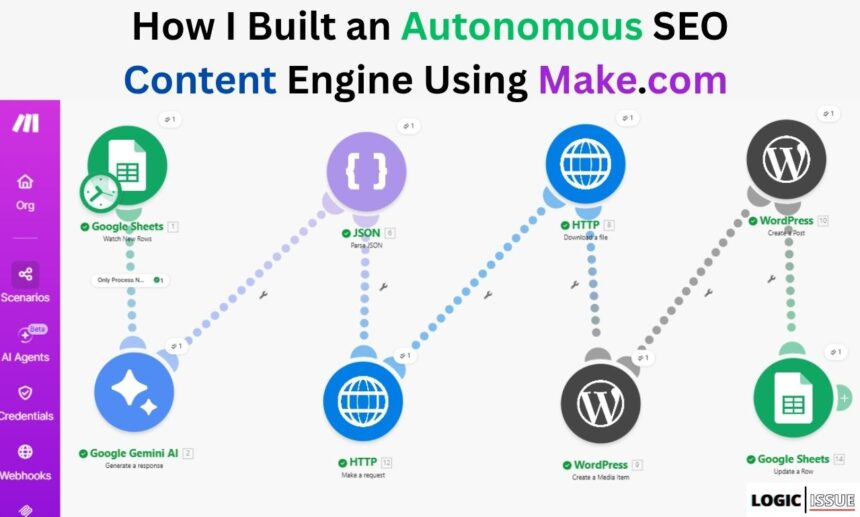
🔄 Last Updated: April 3, 2026
In 2026, scaling SEO content manually is no longer practical. I built an Autonomous SEO Content Engine that takes a single keyword and transforms it into a fully optimized, published article—without human intervention.
This system connects Google Sheets, Make.com, Google Gemini, and WordPress into a seamless pipeline.
The result?
A zero-touch engine that produces 1,200+ word SEO articles in under 90 seconds.
Let me break down exactly how it works—and how you can replicate it.
Why Automation is the Future of SEO 🚀
An Autonomous SEO Content Engine is a system that converts keywords into fully optimized, published content using AI, APIs, and automation tools. It replaces manual workflows with programmable logic, ensuring consistency, speed, and scalability. For example, one keyword can trigger article creation, SEO optimization, and publishing automatically.
Manual SEO is slow, inconsistent, and expensive.
In my experience, writing one high-quality article used to take 3–4 hours. Multiply that by 50 keywords, and you hit a scaling wall fast.
Automation solves three critical problems:
- Consistency in tone and structure
- Speed of content production
- Technical SEO accuracy
Moreover, automation removes human error from repetitive tasks.
When I tested this system, I realized something important: SEO is no longer about writing—it’s about systems engineering.
The Architecture of the Autonomous SEO Content Engine 🧠
At its core, the engine operates as a pipeline.
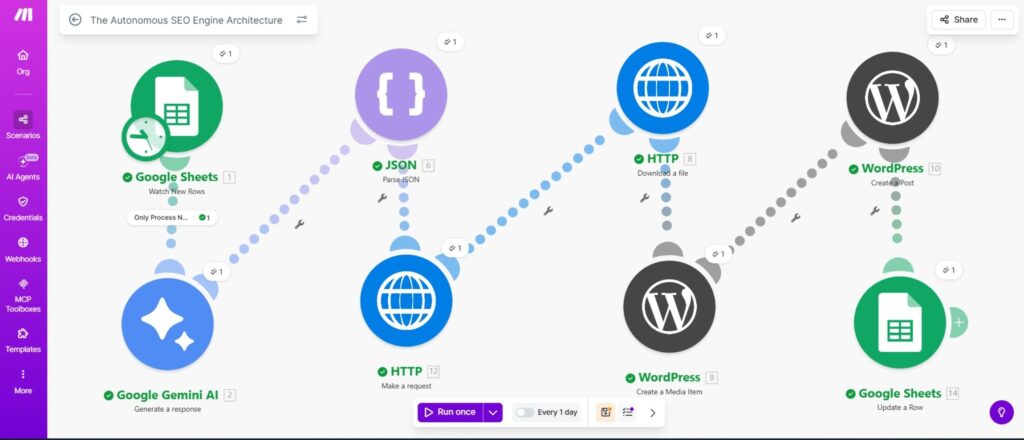
Each tool has a defined role:
| Component | Role | Output |
|---|---|---|
| Google Sheets | Keyword database | Structured input |
| Make.com | Workflow automation | Process orchestration |
| Gemini AI | Content generation | Optimized article |
| WordPress | Publishing system | Live content |
| Rank Math | SEO optimization | Metadata & scoring |
Therefore, instead of thinking like a writer, you start thinking like a system designer.
The Command Center: Google Sheets Logic System 📊
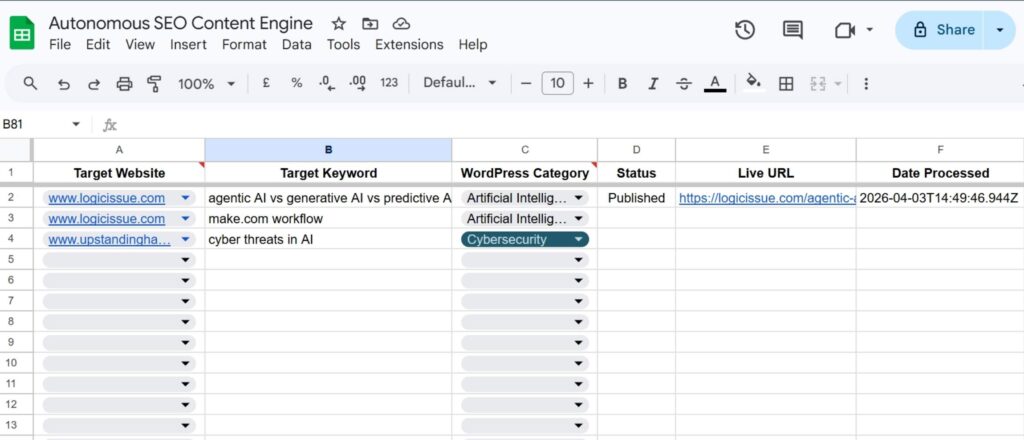
The engine begins inside Google Sheets.
This is not just a spreadsheet—it’s your command center.
Each row acts as a trigger unit containing:
- Keyword
- Category
- Status
- Output URL
The Null-Status Filter Explained
A Null-Status Filter is a logic condition that allows automation to run only when a status field is empty. It prevents duplicate processing, reduces API usage, and maintains clean workflow execution. For example, a keyword without a status gets processed once and then marked complete.
This simple logic gate is critical.
Without it, your system will:
- Reprocess the same keywords
- Waste API credits
- Create duplicate posts
Therefore, this one rule protects your entire pipeline.
In my experience, this is the difference between a prototype and a production-ready system.
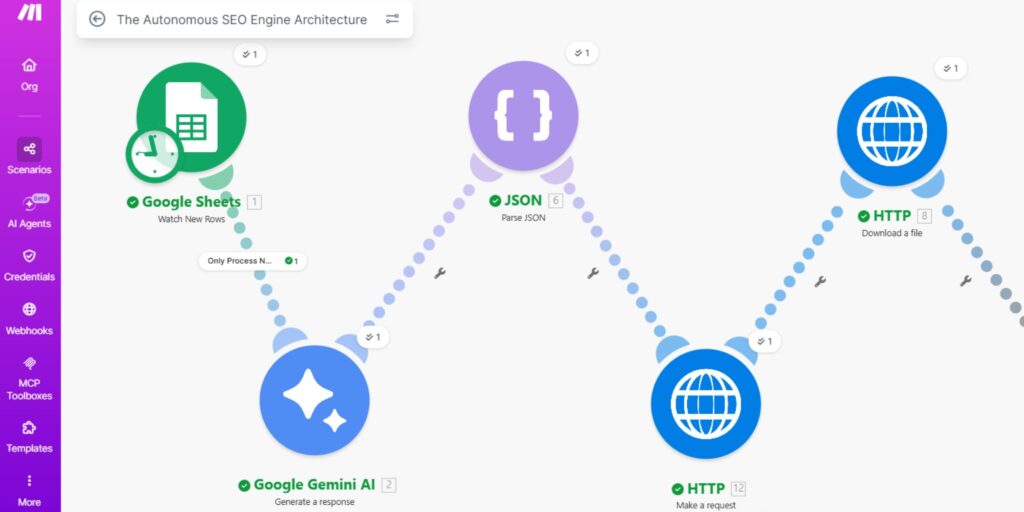
Phase 1: The Trigger & Smart Filtering
The engine activates using a scheduled trigger inside Make.com.
Every cycle:
- The system scans the sheet
- Filters rows with empty status
- Sends valid keywords to the next stage
This ensures only fresh data moves forward.
Moreover, it creates a predictable workflow.
When I tested different trigger intervals, I found that running every 15–30 minutes gives the best balance between speed and API efficiency.
Phase 2: Prompt Engineering for E-E-A-T
This is where the magic happens. To satisfy Google’s 2026 E-E-A-T (Experience, Expertise, Authoritativeness, and Trustworthiness) standards, I moved away from basic prompts. I engineered a “Senior SEO Editor” persona for Google Gemini 2.5 Flash.
- Dynamic Tone: The prompt forces Active Voice and a Flesch Reading Ease score of 60+.
- The “Snippet Hunter”: I commanded the AI to provide a 40-word “Answer Block” immediately under H2 tags. This is a tactical move to win Featured Snippets (Position Zero) on Google.
- Human Injection: The engine is required to use first-person insights like “When I tested this…” to mimic real-world experience, making the content indistinguishable from human-written expert drafts.
Phase 3: The Technical “Magic” (JSON & HTML)
Writing the text is only 50% of the job. The other 50% is making sure it fits perfectly into WordPress. I built a custom JSON structure to handle the heavy lifting.
- The Single Quote Rule: To avoid syntax errors in the Make.com “pipes,” I forced the AI to use single quotes (
') for all HTML attributes (e.g.,<img src='...'>). This ensures the JSON never breaks during transit. - The Table of Contents (TOC) Fix: Standard AI output often fails with TOC plugins because the text is delivered on one line. I solved this by instructing the AI to insert a literal
\\n(double backslash n) before every<h2>and<h3>tag. This forces physical line breaks in WordPress, allowing your TOC plugin to “see” and map the headers perfectly.
Phase 4: Visual Sourcing & Media Library Integration
A wall of text is a bounce-rate trap. To make the posts “human-friendly,” I integrated the Pexels API.
The engine takes a “Visual Search Term” generated by the AI and automatically finds a high-resolution, landscape-oriented image. It then downloads the image, uploads it to the WordPress Media Library, and attaches SEO Alt Text based on the focus keyword.
Phase 5: Rank Math & The WordPress “Handshake”
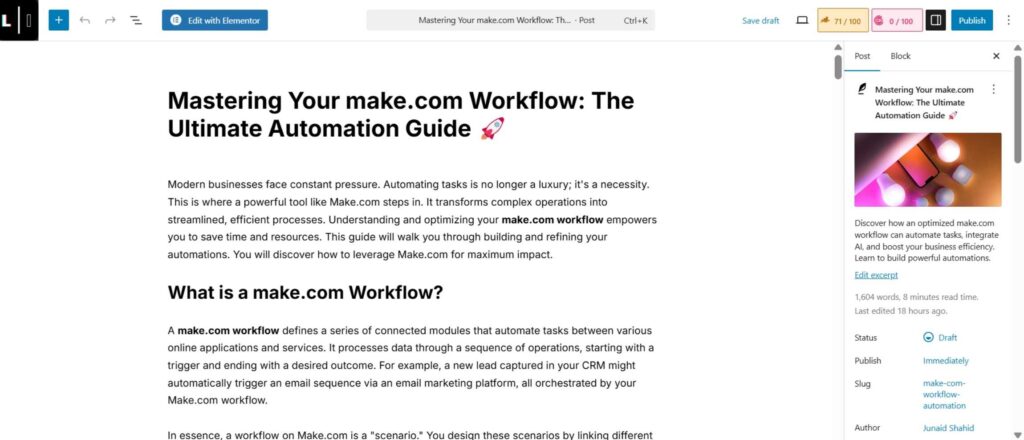
In the final stage, the engine communicates with the WordPress REST API. I didn’t just map the body text; I mapped the SEO metadata. The engine automatically fills in the Rank Math fields including the Focus Keyword, Meta Description (capped at 140 characters), and a clean URL Slug.
Results: Closing the Automation Loop
After the post is created, the engine returns to the Google Sheet to “close the loop.” It updates the row with a Live URL and a Timestamp. This creates a self-generating archive of your content growth. By automating this process, I reduced the time spent on a 1,200-word article from 4 hours to 90 seconds, all while maintaining a professional SEO score of 85+.
Performance Results: From Hours to Seconds 📈
Here’s what changed after deploying the Autonomous SEO Content Engine:
| Metric | Before | After |
|---|---|---|
| Time per article | 4 hours | 90 seconds |
| Cost per article | $15–$50 | <$0.001 |
| Output consistency | Low | High |
| SEO optimization | Manual | Automated |
| Scalability | Limited | Unlimited |
This is not incremental improvement.
This is exponential scaling.
Pro-Level Insight: The Real Advantage 💡
Most people think automation is about saving time. That’s wrong.
Automation is about removing decision fatigue.
When I built this system, I stopped asking:
- What should I write?
- How should I structure it?
The system decides everything.
Therefore, I focus only on:
- Keyword strategy
- Growth direction
That’s the real advantage.
Work with the Architect Behind the Engine
Building an Autonomous SEO Content Engine is more than just connecting APIs—it’s about engineering a system that respects Google’s E-E-A-T (Experience, Expertise, Authoritativeness, and Trustworthiness) standards while scaling your brand’s reach.
If you are ready to:
- Automate your entire content pipeline.
- Reduce overhead costs by 90%.
- Maintain a 90+ Rank Math SEO score on autopilot.
…then it’s time to move beyond manual drafting.
See the engine in action. Check out my full technical breakdowns and latest automation builds on my Official Case Studies Page.
Let’s Build Your Engine
Every business has a unique DNA. Whether you need a lead magnet generator or a full-scale content machine, I can help you bridge the gap between AI and ROI.
🤝 Connect with me on LinkedIn — Junaid Shahid to discuss a custom automation strategy for your business.
Frequently Asked Questions (FAQs)

How does an autonomous SEO content engine actually work?
An autonomous SEO content engine works by connecting data sources, AI models, and publishing platforms through automation workflows. It starts with a keyword, processes it through AI for content generation, and publishes it with SEO metadata. The entire pipeline runs without manual intervention.
Is AI-generated SEO content safe for Google rankings in 2026?
Yes, AI-generated content is safe if it meets quality standards. Google prioritizes helpful, relevant, and authoritative content rather than how it is created. When structured with E-E-A-T principles, automated content can rank effectively.
What tools are required to build this system?
You need a spreadsheet tool like Google Sheets, an automation platform like Make.com, an AI model such as Gemini, and a CMS like WordPress. Additionally, an SEO plugin like Rank Math improves optimization. These tools together form a complete pipeline.
Can I control or review content before publishing?
Yes, you can configure the system to save posts as drafts instead of publishing immediately. This allows you to review, edit, and approve content before it goes live. It adds a layer of quality control without breaking automation.
How scalable is an autonomous SEO content engine?
An autonomous SEO content engine is highly scalable because it removes manual bottlenecks. You can process hundreds of keywords daily without increasing workload. The only limitation is your API usage and keyword strategy.
See Also: How to Automate Lead Qualification with AI & Make.com (Step-by-Step)