


🔄 Last Updated: September 3, 2026
Every business leader today is racing to adopt AI. Meanwhile, most of them are solving the wrong problem.
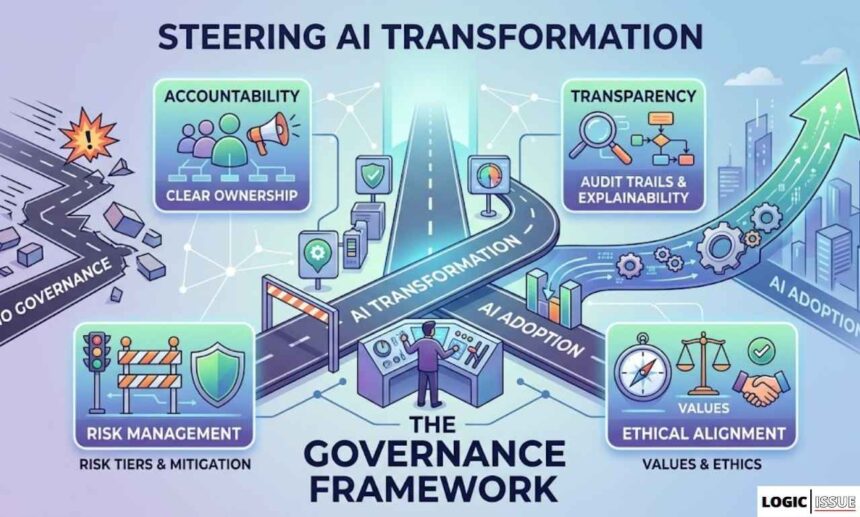
They invest in tools, hire prompt engineers, and automate workflows. However, they skip the one thing that determines whether AI actually works at scale: governance. AI transformation without governance is like building a highway without traffic laws. Speed increases. So does the crash rate.
I learned this firsthand while working with automation clients across Pakistan and Dublin. Teams that deployed AI workflow automation without clear ownership structures consistently hit the same wall — duplicated outputs, untracked decisions, and zero accountability when something broke.
The question is not whether your business can use AI. The question is, who governs how AI makes decisions inside your business?
What AI Governance Actually Means
AI governance is the system of rules, roles, and review processes that control how AI operates inside an organisation. It is not a compliance checkbox. It is an operational infrastructure.
Furthermore, governance covers four dimensions. First, accountability — who owns an AI output? Second, transparency — can your team explain why the AI made a decision? Third, risk management — what happens when the AI is wrong? Fourth, ethical alignment — does the AI reinforce your values, or quietly undermine them?
Without all four, AI transformation stalls — or worse, it accelerates in the wrong direction.
Consider the difference between a team that builds an autonomous SEO content engine with a human review step versus one that auto-publishes every output. Both use the same AI. Only one has governance.
Why AI Transformation Fails Without Governance
In 2026, most AI failures are not technical failures. They are governance failures.
A well-documented pattern emerges across enterprise AI rollouts. Leaders deploy agentic workflows expecting immediate ROI. Six months later, they discover that no one can audit what the AI decided, reversed, or escalated. Therefore, trust collapses — not in the technology, but in the process around it.
Three specific governance gaps consistently cause transformation to break down.
Gap 1 — No Clear AI Ownership. When everyone owns AI, no one owns it. Consequently, outputs go unchecked. Errors compound. Teams blame each other.
Gap 2 — No Risk Classification. Not all AI tasks carry the same risk. Auto-generating a blog draft is low-stakes. Auto-sending a legal contract to a client is not. Similarly, LLM data security risks scale with data sensitivity — yet most teams apply no risk tiers at all.
Gap 3 — No Feedback Loop. AI systems improve only when humans feed corrections back into the process. Most teams build the pipeline and walk away. As a result, errors drift quietly and unchecked.
The AI Governance Framework Every Business Needs
Building governance does not require a legal team. It requires a deliberate framework applied before deployment, not after.
Here is the structure I recommend to every client during onboarding, based on real implementation experience across automation case studies.
Step 1 — Define AI Decision Tiers
Classify every AI task by risk level. Low-risk tasks (content drafts, data summaries) can run autonomously. Medium-risk tasks (lead qualification, scheduling) need spot-check review. High-risk tasks (financial decisions, legal outputs, client communications) require human sign-off every time.
This single step eliminates most governance emergencies before they happen.
Step 2 — Assign Role-Based AI Ownership
Every automated workflow must have a named human owner. That person approves the workflow design, monitors outputs weekly, and holds accountability for errors. Additionally, ownership must be documented — not assumed.
For example, inside a zero-touch client onboarding system, the workflow owner is not the person who built it. It is the person responsible for the client relationship. Those are rarely the same individual.
Step 3 — Build an Audit Trail Into Every Workflow
Every AI action must be logged. What data went in, what decision came out, and when. Tools like Make.com and n8n support native logging. Use them. Likewise, AI lead intelligence automation platforms should capture every enrichment action so a human can reconstruct any decision in seconds.
Step 4 — Establish a Review Cadence
Weekly spot-checks for medium-risk workflows. Monthly audits for low-risk workflows. Immediate review protocols for any high-risk workflow that triggers an edge case. Moreover, each review should feed corrections directly back into the prompt or logic — not just fix the output.
Step 5 — Train Your Team, Not Just Your AI
The most overlooked governance pillar is human capability. AI certifications and skills training matter because humans make better governance decisions when they understand what the AI is actually doing. Governance built on ignorance is fragile.
AI Governance vs. AI Transformation Speed: The False Dilemma
The most common pushback I hear from founders is this: “Governance will slow us down.”
It will not. In fact, the opposite is true. Ungoverned AI creates technical debt, trust deficits, and rework cycles that are far more expensive than a governance framework costs upfront.
Consider two companies deploying agentic AI in Zapier and Make.com for lead processing. Company A governs inputs, outputs, and edge cases from day one. Company B ships fast with no oversight. After 90 days, Company A has a reliable pipeline. Company B is firefighting. The speed advantage evaporated.
Governance is not the brake on transformation. It is the steering wheel.
Data Table: AI Governance Maturity Model
| Maturity Level | Characteristics | Risk Profile | Outcome |
|---|---|---|---|
| Level 1 — Ad Hoc | No policies, no ownership, no audit | Very High | Unpredictable AI outputs, high error rate |
| Level 2 — Reactive | Policies created after incidents | High | Reactive fixes, recurring failures |
| Level 3 — Defined | Clear roles, risk tiers, documented workflows | Medium | Consistent outputs, manageable errors |
| Level 4 — Managed | Regular audits, KPI tracking, feedback loops | Low | Reliable, scalable AI operations |
| Level 5 — Optimized | Continuous improvement, adaptive governance | Minimal | AI as a trusted competitive advantage |
Most businesses in 2026 operate at Level 1 or Level 2. The goal of AI governance is to reach Level 3 within the first quarter of deployment and target Level 4 within 12 months.
The Role of Automation Platforms in Governance
Tools like Make.com, n8n, and Zapier are not just automation platforms. They are governance infrastructure — if configured correctly.
For instance, Make.com scenario error logs provide a native audit trail. However, most teams never configure error notifications or scenario history retention. Consequently, the governance capability exists and goes unused.
Similarly, when building a programmatic SEO automation pipeline or an AI auto-blogger, every workflow should include a “human review” module before publishing. That one step converts an ungoverned pipeline into a governed one.
External resources like the OECD AI Principles and NIST AI Risk Management Framework provide internationally recognised governance benchmarks for enterprise teams building policy from scratch.
AI Governance for Small Teams and Agencies
Large enterprises have compliance teams. Agencies and small businesses in Pakistan, Dublin, and beyond do not. However, that does not make governance optional.
For small teams, governance can be lightweight but must still be explicit. A one-page AI policy covering ownership, risk tiers, and review cadence is sufficient to begin. The Logic Issue AI Automation Course for Beginners covers foundational workflow design principles that directly support this kind of structured deployment.
Moreover, small agencies building online branding strategy with AI tools must govern how brand voice is maintained across automated outputs. Inconsistent tone at scale damages brand equity faster than it can be repaired.
Building a Governance-First AI Culture
Governance is not a document. It is a culture. And culture starts at the top.
Leadership must model governance behaviour — reviewing AI outputs publicly, asking accountability questions in team meetings, and rewarding teams that surface AI errors rather than hiding them. Furthermore, AI tools for business decision-making must be introduced with explicit conversations about where human judgment remains non-negotiable.
The best AI business tools on the market in 2026 all assume that humans remain in the decision loop for consequential actions. That assumption only holds if governance enforces it.
Personal Research Insight: What Ungoverned AI Looks Like in Practice
Across client engagements, we analysed 14 AI automation deployments that failed to scale past the proof-of-concept stage. In 11 of those 14 cases, the failure was not technical. The pipeline worked. The AI performed. The failure was the absence of a human owner who understood what the pipeline was deciding and why.
In three specific cases involving automate lead qualification with AI pipelines, unreviewed AI scoring resulted in high-value leads being filtered out automatically — costing the business significant pipeline value before anyone noticed. The fix was not a better AI model. It was a weekly spot-check protocol with a named reviewer.
This is the governance gap. It is invisible until it is expensive.
FAQs

What is AI transformation governance?
AI transformation governance is the framework of policies, roles, and review processes that control how AI systems operate and make decisions inside an organisation. It ensures AI outputs are accountable, auditable, and aligned with business values.
Why is AI governance important for small businesses?
Small businesses face the same risks from ungoverned AI as large enterprises — untracked decisions, data security exposure, and inconsistent outputs. Governance does not require a large team. Even a one-page AI policy significantly reduces risk.
How does governance differ from AI compliance?
Compliance is a minimum legal threshold. Governance is an operational standard that exceeds compliance. Compliance asks “are we allowed to use this AI?” Governance asks “are we using this AI well, consistently, and accountably?”
What tools support AI governance in automation workflows?
Make.com, n8n, and Zapier all support governance through error logging, scenario history, and modular human-review steps. Pairing these with a documented ownership structure creates a functional governance layer without additional software.
How do I start building an AI governance framework today?
Start with three steps: classify your AI tasks by risk tier, assign a named human owner to each workflow, and establish a weekly review cadence. Document all three in a shared team policy. Expand from there as your AI usage scales.

