

Implementing an effective startup booted fundraising strategy is crucial where the landscape is ever-evolving and competition fierce. Your ability to secure funding can make or break your venture. As an entrepreneur, you understand that traditional fundraising routes may not always align with your innovative vision.
Enter the bootstrapping strategy—a powerful, self-sustaining approach to funding that leverages existing resources and creativity. This article will guide you through the intricacies of booted fundraising, offering insights and practical advice to help you unlock the potential of your startup. Prepare to explore a strategy that fosters resilience and positions your venture on the path to success.
What Is a Startup Booted Fundraising Strategy?
Core Principles
A startup booted fundraising strategy emphasizes building and growing a business using minimal external capital. This approach fosters financial discipline and prioritizes using personal savings and early revenue streams to fund operations. It champions a customer-driven growth mindset, allowing startups to develop a product-market fit organically without external investor pressures.
Benefits and Challenges
This strategy provides several advantages, such as full ownership retention and lower risks of failure. Startups can operate with strong financial discipline, avoiding early dependence on venture capital. However, it may also result in slower growth and limited resources, presenting unique scaling challenges. A careful balance between cost management and innovative scaling methods is crucial.
Long-Term Viability
In the long term, a start-up booted fundraising strategy nurtures sustainability and resilience. By focusing on internal revenue and disciplined spending, startups position themselves for stable growth, which aligns with modern global entrepreneurial trends. The goal is to build lasting businesses capable of surviving lean periods and engaging strategically with investors when ready, leading to favorable funding terms.
Understanding the Philosophy Behind Booted Fundraising
Startup booted fundraising strategy champions self-sustainability over dependence on external capital. By prioritizing internal revenue and strategic reinvestment, entrepreneurs are encouraged to focus on core business fundamentals, making profitability and customer satisfaction the main markers of success. This approach nurtures creativity and effective decision-making, devoid of external investor pressure. Consequently, it aligns more closely with true market demands, ensuring businesses build robust, resilient foundations capable of withstanding economic volatilities.
Why Startups Choose Booted Fundraising
Independence and Control
A major reason startups opt for a startup booted fundraising strategy is to maintain autonomy. By avoiding external investors, founders retain complete control over company decisions, keeping their vision intact. This approach allows startups to evolve at their own pace without the pressure from investors demanding rapid scaling.
Financial Discipline and Sustainability
Bootstrapping instills financial discipline, encouraging thoughtful spending and efficient resource use. Startups focused on sustainable growth can develop a solid foundation for future expansion, prioritizing customer needs over quick scaling goals.
How the Startup Booted Fundraising Strategy Works
Focus on Financial Self-Reliance
A startup booted fundraising strategy emphasizes using personal savings and early business revenue to fuel growth, minimizing reliance on external investors. This approach fosters a robust financial discipline, allowing founders to maintain control while deriving funds organically from operations. By prioritizing self-reliance, startups cultivate resilience and adaptability, ensuring that growth is sustainable and aligned with real market needs. Founders thus achieve success through operational discipline and a keen customer focus.
Building Through Customer Relationships
By leveraging customer-funded models, startups pivot towards sustainable growth, engaging customers as pivotal stakeholders. This strategy promotes a customer-centric approach, emphasizing product-market fit through iterative feedback and adaptation. Strong customer relationships generate stable revenue, which acts as a financial bedrock, reducing the risks associated with aggressive scaling and external investment pressures. This organic growth fosters long-term stability and business credibility.
Operational Efficiency and Strategic Resource Use
Efficiency is central to the booted fundraising approach. Founders streamline operations by managing cash flow meticulously and making ROI-driven decisions. Lean practices, such as developing a minimum viable product and employing budget-conscious marketing strategies, ensure resources are utilized effectively. While financial constraints pose challenges, they also drive creative solutions and strategic growth, positioning startups strongly for potential future external investments from a position of strength.
By adopting the startup booted fundraising strategy, entrepreneurs craft a business foundation that is resilient, controlled, and closely aligned with customer needs, enabling them to navigate the competitive landscape successfully.
Key Benefits of a Startup Booted Fundraising Strategy
Enhanced Control and Ownership
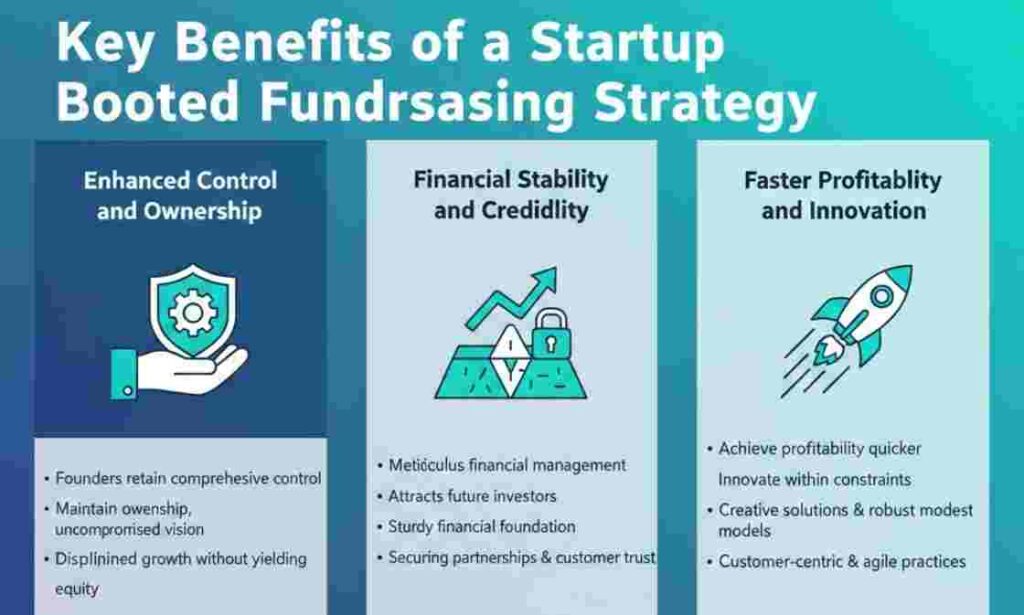
A startup booted fundraising strategy empowers founders to retain comprehensive control over their business decisions. By avoiding external investments, entrepreneurs maintain ownership, ensuring their vision remains uncompromised. This strategic approach provides a platform for disciplined growth, steering the company towards sustainable success without yielding equity as detailed by Investopedia.
Financial Stability and Credibility
Bootstrapping often demands meticulous financial management, enhancing a startup’s credibility. This discipline not only attracts future potential investors but also lays a sturdy financial foundation, vital for navigating market challenges. Establishing credibility is crucial for securing partnerships and customer trust.
Faster Profitability and Innovation
Bootstrapped startups frequently achieve profitability quicker than those reliant on external funds. By leveraging personal finances or operating revenue, entrepreneurs are incentivized to innovate within constraints, fostering creative solutions and robust business models. This approach nurtures a culture of customer-centric innovation and agile practices, pivotal for impactful growth.
This startup booted fundraising strategy serves as a testament to the strengths of maintaining operational control, achieving financial sustainability, and fostering innovation, key to unlocking long-term success.
Common Mistakes in Startup Booted Fundraising Strategy
Raising Capital Prematurely
One prevalent blunder in a startup booted fundraising strategy is raising capital prematurely. Contrary to some founders’ beliefs, attracting investors too early may actually hinder progress. Investors often seek evidence of capability—the ability to turn ideas into tangible products with limited funds. By first demonstrating your startup’s potential and building credibility, you strengthen your position before engaging with investors.
Undervaluing Relationship Building
Another frequent mistake is undervaluing the significance of relationship building with potential investors. Viewing funding rounds as mere transactions rather than long-term partnerships can lead to missed opportunities. Proactively networking and fostering genuine connections can differentiate your venture.
Misjudging Valuation and Funding Needs
Furthermore, startups often misjudge their valuation and funding requirements, leading to either dilution or undercapitalization. It’s crucial to base valuations on demonstrated traction rather than mere projections. Industry benchmarks offer helpful guidance to align with realistic industry expectations.
Booted Fundraising vs. Venture Capital Funding: A Balanced Comparison
Equity and Control
Bootstrapping offers founders complete equity retention and control, empowering them to make independent decisions without external pressures. Conversely, venture capital funding requires exchanging equity for capital, often resulting in significant dilution and potential loss of control as investors secure board positions and influence business directions. Founders must weigh these considerations based on their strategic priorities and vision for the company.
Growth Trajectory
Venture capitalists inject substantial funds enabling rapid, aggressive growth, pivotal for markets demanding speed and scale. However, a startup booted fundraising strategy fosters sustainable growth. By focusing on disciplined financial management and organic scaling, founders can build robust, profitable businesses with reduced personal financial risk and stress. This method thrives in service-based industries and where long-term stability is prioritized.
Strategic Flexibility
Both methods present distinct strategic benefits. Bootstrapping endows the liberty to focus on long-term objectives and profitability without investor-driven exit pressures. Meanwhile, VC funding offers strategic partnerships and network access, accelerating market positioning. Many successful startups utilize a hybrid model—inception through bootstrapping followed by VC funding—to validate ideas and optimize valuation before scaling aggressively.
Conclusion
In navigating the intricate landscape of startup fundraising, you have uncovered the foundational strategies to propel your venture toward success. By harnessing targeted networking, cultivating a compelling narrative, and leveraging innovative financial models, you position yourself to attract the right investors who align with your vision. Remember, the journey of fundraising is as much about persistence and adaptability as it is about securing capital. As you continue on this path, let your passion and resilience serve as the guiding compass, transforming challenges into stepping stones and opportunities into milestones. Your startup’s success story begins with the strategic steps you take today.
See Also: Effective Workplace Management EWMagWork Strategies
